The first three seconds of a short decide whether the rest gets watched, and three edits do most of the work: open punched in on the speaker's face at about 1.2-1.4x and settle out, put your strongest line on screen as a bold hook title, and cut into the middle of a sentence instead of a greeting. Zella's Auto-Polish builds all three, settling the opening punch over roughly 1.7 seconds.
Watch any short that performed and scrub the first three seconds frame by frame. You will almost never find a wide, static shot of someone saying "hey guys." You will find a face close to the lens, a bold line of text, and a sentence already in motion. That is not an accident - it is the most consistent editing pattern in short-form video, and it is entirely buildable in the edit, after you have recorded.
Why the first 3 seconds carry the whole video
Feeds are auditions. TikTok, Reels and Shorts measure whether a viewer stays past the first moments and use it to decide how widely to show the video. If your opening loses people, nothing you did at second 40 matters, because almost nobody arrives at second 40. Retention graphs make this brutal and visible: the steepest drop is nearly always in the first three seconds.
The good news: the opening is the one part of the video you can fix mechanically. You do not need a better personality - you need three edits.
The measured version of "you have seconds": Nielsen Norman Group's dwell-time work found users often leave within 10 to 20 seconds absent an obvious payoff. Your own numbers are in YouTube's audience retention report, where the dips line up with the exact moments people left.
People do not read carefully on a screen, and they never did: Nielsen Norman Group's how users read on the web is the research most copy is written in defiance of.
Edit 1: start punched in, then settle
Start the video zoomed into the speaker's face - roughly 1.2× to 1.4× - and ease back out to the normal framing over one to two seconds. It reads as energy and intimacy, and the outward motion itself is a hook: the frame is moving, so the eye stays.
Two details matter. Anchor the zoom on the face, not the frame center, or the punch drifts off you. And settle, don't cut - a smooth ease-out over ~1.5-2 seconds feels intentional; a hard jump back feels like a mistake.
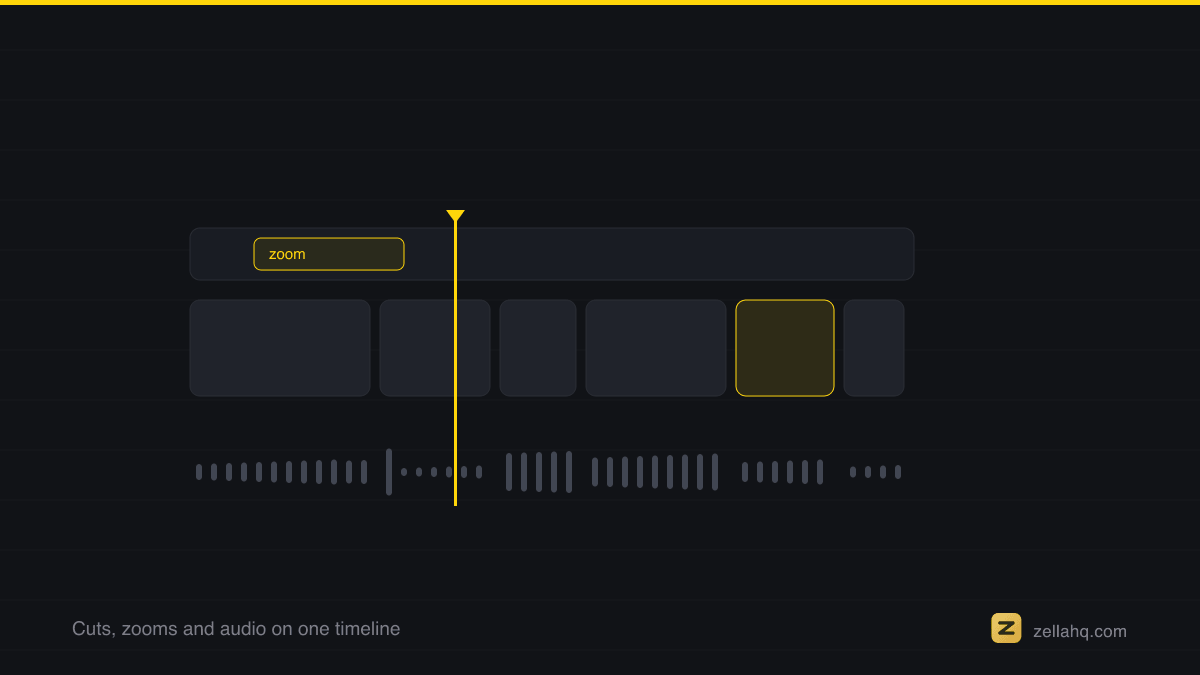
In Zella, Auto-Polish does this as its opening-hook step: it finds your face, starts punched in about 1.3×, and settles out over roughly 1.7 seconds, timed to pair with the hook title. If you edit manually, a zoom block with an eased exit does the same job.
Edit 2: put the hook in text
Most viewers start muted or half-listening. A bold title carrying your strongest claim - on screen for seconds one through three - hooks the readers as well as the listeners. Use your first spoken line if it is strong, or pull the most surprising claim from anywhere in the video forward.
Keep it big, high-contrast, and shorter than eight words. Zella's Auto-Polish builds this automatically: a canvas-fit hook title from your first spoken line, so the text hook exists even when you forgot to plan one.
Edit 3: cold-open into the middle of a sentence
Cut your greeting. Start the video where the first interesting clause begins - mid-sentence is fine, and often better, because an in-progress sentence creates an open loop the brain wants closed. In practice this means your first cut of the edit is a trim: delete everything before the first line that would survive as a tweet.
Putting the three hook edits together
- Trim to the first strong sentence (delete the greeting).
- Add a hook title with that sentence's claim.
- Start punched in ~1.3× on the face, settle out over ~1.7 s.
- Make sure a cut or movement happens before second 4 - never let the opening sit still.
On a phone, one tap of Auto-Polish runs the hook title and opening punch as steps in its full pipeline; on the Mac the same pieces are one click each. Either way, stop treating the opening as "the start of the recording" - treat it as its own three-second video that earns the rest.
Common mistakes that kill a hook
- Opening with "hey guys, welcome back." A greeting is dead air with a face on it. Viewers came to feel, learn or solve something - not to meet you.
- A slow logo sting or intro animation. Any two seconds of branding before the content is a guaranteed scroll trigger. Put the logo at the end, if anywhere.
- A wide, static shot. No movement in the frame reads as "nothing is happening." Start punched in or start on motion.
- Burying the hook in the audio only. Most viewers start muted. If your claim isn't on screen as text, half the audience never gets it.
- A hook you can't pay off. Curiosity gaps work only if the answer lands. Over-promise and the retention you win in second 2 you lose in second 10.
Frequently asked questions
Why do the first 3 seconds of a video matter so much? Feeds decide how widely to show a video based on whether early viewers stay. The steepest drop on almost every retention graph is in the first three seconds, so an opening that loses people caps everything after it - most viewers never reach second 40.
What makes a good hook for a Reel or Short? Immediate stimulation (a face close to the lens or on-screen motion), an open loop (a question or claim you'll pay off), and relevance (the viewer sees the value by about second two). A bold text hook carries all three for muted viewers.
How long should a hook be? The visual and text hook should be established within the first 1-3 seconds, and the spoken claim should land by roughly second two. Keep a text hook under eight words so it reads at a glance.
Should I say my name at the start of a short? No. Introductions and "welcome back" are the most common scroll triggers. Cold-open into the first interesting sentence and save any introduction for later, if at all.
Can I add a hook after recording? Yes - that is the point. A punch-in, a hook title and a cold-open trim are all edit-side moves. You can pull the strongest line from anywhere in the take forward to the front.
Make your next video with Zella.
Record, edit and ship on Mac and iPhone - local, private, free to start.
PART OF A SERIES
Strong openings and hooks
The first seconds, where a viewer decides whether stopping was a mistake.
- How to Hook Viewers in the First 3 Seconds of a Shortyou are here
- The Three Edits That Fix a Weak Video Opening
- How to Add a Hook Title to the Start of a Video
All of it lives under One-Click.
RELATED