Aim for about -14 LUFS for YouTube, TikTok and Reels, the level most creators and editors use for social video, and keep true peaks below -1 dBTP. For podcasts, Apple Podcasts recommends about -16 LKFS with a 1 dB tolerance. Zella's Polish Voice sets your voice to about -14 LUFS on Mac and iPhone.
On this page
For a video on YouTube, TikTok or Reels, about -14 LUFS integrated is the level most editors aim for, with true peaks kept under -1 dBTP so nothing clips after the platform re-encodes it. For a podcast, Apple Podcasts asks for about -16 LKFS, plus or minus 1 dB. Those two numbers cover nearly every creator.
This guide explains what LUFS measures, which numbers are published by whom, and how to land near the target without a meter, using Zella on Mac or iPhone.
What LUFS means
LUFS stands for Loudness Units relative to Full Scale. It measures how loud audio sounds to people, not how high its peaks reach. The method is defined in ITU-R BS.1770, an international standard, and LKFS is the same measurement under another name. One LU equals one dB of change.
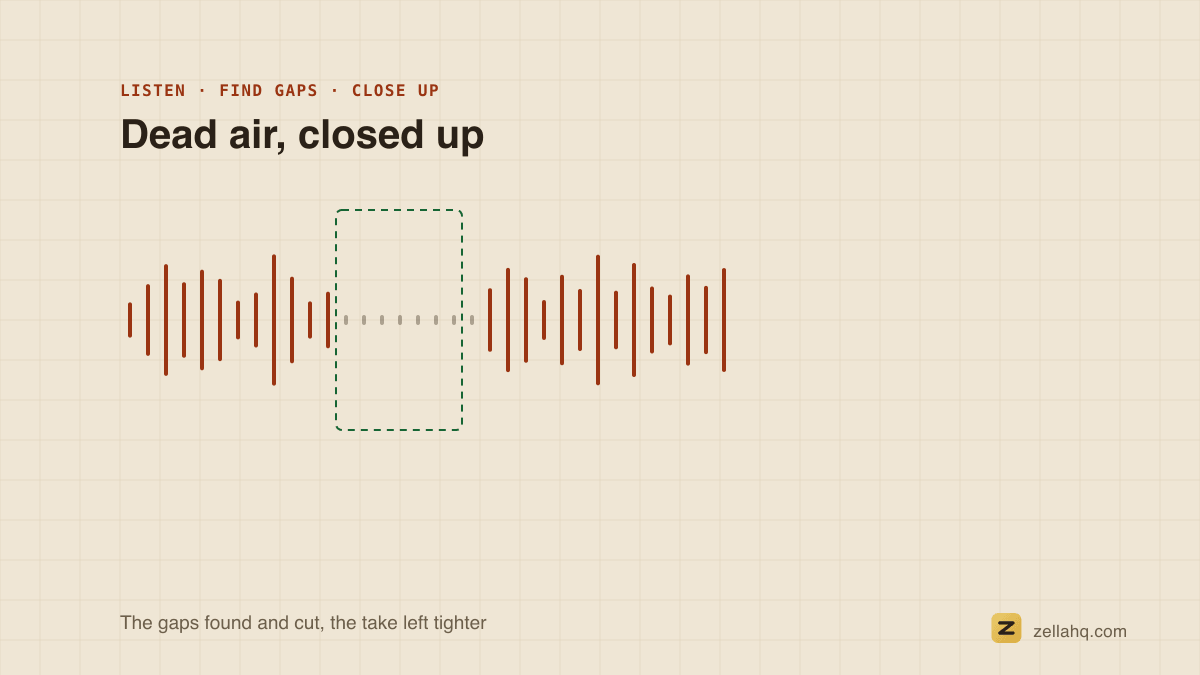
Three readings matter:
- Integrated loudness: the average over the whole file. This is the number targets refer to.
- True peak (dBTP): the highest point of the waveform, including peaks that appear between samples after conversion.
- Loudness range (LU): how much the loudness moves between quiet and loud parts.
Numbers are negative because they are measured below full scale. -14 LUFS is louder than -16, and -23 is quieter than both.
Why platforms care
Most streaming services turn loud uploads down so a viewer does not jump from a whisper to a shout between videos. That is loudness normalisation. If your video is far louder than the platform's playback level, it gets turned down and gains nothing. If it is far quieter, it may sound weak next to the video before it, because not every service turns quiet audio up.
So the goal is not "as loud as possible". It is "at the level the feed plays at, with clean peaks".
The numbers, and where they come from
| Destination | Target | Source |
|---|---|---|
| YouTube | About -14 LUFS | Common practice; YouTube does not publish one required number in its help centre |
| TikTok, Instagram Reels, Shorts | About -14 LUFS | Common practice; no published target we could find |
| Apple Podcasts | About -16 LKFS, plus or minus 1 dB, true peak no higher than -1 dBFS | Apple Podcasts audio requirements |
| European broadcast TV | -23 LUFS | EBU R 128 |
Be wary of any article that quotes an exact, official TikTok or Instagram loudness target. We could not find one published by either company. The -14 figure is the level editors converge on because it plays well across all of them.
How to hit about -14 LUFS in Zella
Zella has no loudness meter. What it has is a voice chain that targets the right level for you.
On the Mac:
- Click Auto Tools → Remove Noise if there is fan, hum or hiss behind the voice.
- Click Auto Tools → Polish Voice. It runs a high-pass filter, de-esser, compressor and loudness normalising, aiming at about -14 LUFS. Select a clip first to polish only that clip.
- Add music, then Auto Tools → Auto-Duck Music so the bed dips under your voice instead of adding to its loudness.
- Export. The noise gate and a 15.5 kHz roll-off run after the loudness stage, so raising the level does not raise the hiss with it.
On iPhone:
- Tap Auto, then Remove noise and Polish voice.
- Tap Audio and pick a Voice tone. The level target stays the same whatever tone you pick.
- Turn on Music gets quieter when you talk on the music strip.
Auto-Polish runs the noise removal and voice polish together on the phone, if you would rather tap once. Details are in the audio docs and the export docs.
Podcasts: what to do differently
If the same recording goes out as a video and as an audio podcast, export the audio separately. Zella's export dialog has an M4A format, audio only, meant for exactly this.
Polish Voice aims at about -14 LUFS, which is about 2 dB louder than Apple's -16 recommendation. Apple's page asks for audio "preconditioned" around -16 so its own volume adjustments sound natural. If you publish to Apple Podcasts and want to match the recommendation exactly, measure the M4A in a loudness meter (Logic Pro, Audacity and most podcast hosts have one) and lower it by the difference. For most shows the gap is small, but it is a real gap, and we would rather say so than claim one export fits both.
Loudness range: the number nobody mentions
Integrated loudness is an average, so a video can hit -14 LUFS and still swing from a whisper to a shout. That swing is the loudness range. A narrated video with a narrow range is easier to follow on a phone in a noisy place, because the quiet lines do not disappear under the bus or the kitchen. Broadcast standards care about it for the same reason.
You do not need to measure it. If you have to turn the volume up for one sentence and down for the next, the range is too wide. Polish Voice compresses the voice before it normalises, which is what narrows the range.
A short loudness checklist
- Voice cleaned first, music added second
- Polish Voice on the clips with speech
- Music ducked under the voice, not raised to compete
- No red clipping in the waveform at the loudest moment
- Played once on a phone speaker and once on earbuds
- Separate M4A for an audio podcast, measured if you need exactly -16
Common mistakes
- Making it as loud as possible. Platforms turn loud uploads down, so pushing harder only adds distortion.
- Normalising peaks instead of loudness. Setting the highest peak to 0 dB says nothing about how loud it sounds. A file can peak at 0 and still be quiet.
- Measuring the voice, then adding music on top. The music raises the total. Duck it, and check the finished mix.
- Quiet intro, loud ending. A video that starts at a whisper loses people before the point. Polish Voice evens this out across the whole take.
- Trusting an unsourced "official" number. If a platform has not published it, treat it as a rule of thumb.
Resources and further reading
- Zella docs: voice, music and Auto-Duck
- Apple Podcasts: audio requirements
- ITU-R BS.1770: algorithms to measure audio programme loudness and true-peak level
- EBU R 128: loudness normalisation and permitted maximum level (PDF)
Related: what a de-esser and compressor do, background music too loud over your voice, and the ship everywhere feature page.
Frequently asked questions
What LUFS should a YouTube video be? About -14 LUFS integrated is the level most editors use for YouTube, with true peaks below -1 dBTP. YouTube does not publish one required number in its help centre.
What LUFS is TikTok? TikTok has not published a loudness target that we could find. About -14 LUFS, the common social video level, plays well there and on Reels and Shorts.
What LUFS should a podcast be? Apple Podcasts recommends about -16 LKFS, plus or minus 1 dB, with true peaks no higher than -1 dBFS.
Is -14 LUFS too loud? Not for social video. It is the common target. It is about 2 dB louder than Apple's podcast recommendation and much louder than the -23 LUFS used for European broadcast TV.
Does Zella have a loudness meter? No. Polish Voice sets your voice to about -14 LUFS for you. To measure an exact number, export the audio as M4A and check it in a loudness meter.
Written by
Nasir Uddin Shamim
Founder of Zella
Nasir Uddin Shamim is the founder of Zella. He built his career in SEO, AI, and marketing - never short on ideas, but every one of them hit the same wall: turning a raw recording into a video worth posting. Like most beginners, he burned hours fighting complicated editors and shipped far less than he wanted to. So he built Zella, a screen recorder and AI editor for Mac and iPhone that does the hard parts for you - first to unblock himself, and now to help anyone go from raw clip to polished video without the learning curve.
More from Zella: fresh tutorials on the channels above, plus product updates and editing tips straight to your inbox.
Make your next video with Zella.
Record, edit and ship on Mac and iPhone - local, private, free to start.
PART OF A SERIES
A clean, balanced voice
De-essing, loudness targets, muffled voice and balancing clips.
- What a De-Esser and Compressor Do to Your Voice
- What LUFS Should Videos Be for YouTube, TikTok and Podcasts?you are here
- Voice Sounds Muffled After Noise Removal? How to Fix It
- How to Balance Audio Levels Between Clips in a Video
- How to Record a Voiceover on Mac Over Your Video
All of it lives under Sounds & Audio.
RELATED