Auto captions drift out of sync when the caption model writes the right words but only guesses when each one was said. The fix is forced alignment: a second model listens again and pins every word to your voice. Zella does this on the device since 1.0.14, after a one-time free download of about 300 MB.
On this page
- Why captions land early or late
- The fix: a second model that only does timing
- The one-time 300 MB download, and why
- What changed in measured numbers
- How to get synced captions
- When captions still feel off
- How to check sync in thirty seconds
- Common mistakes
- What it does not do
- Resources and further reading
- Frequently asked questions
Auto captions drift out of sync because writing down what was said and knowing when each word was said are two different jobs. Most caption models are good at the first and only estimate the second, so words land a little early or late. The fix is forced alignment: a second model listens again and pins each word to the moment you say it.
Zella does that on your Mac or iPhone since version 1.0.14, on every plan, after a one-time free download of about 300 MB. This guide explains the cause, the fix, and what to check when captions still feel off. Download Zella free to try it on your own footage.
Why captions land early or late
A speech model hears audio in chunks. Zella's Bangla model on the Mac, for example, hears up to 30 seconds at a time and reports no times inside that window. The model knows the words in the chunk, but not where each word starts. Older versions of Zella had to guess, spreading the words across the chunk, and a guess is wrong whenever you pause, speed up or slow down.
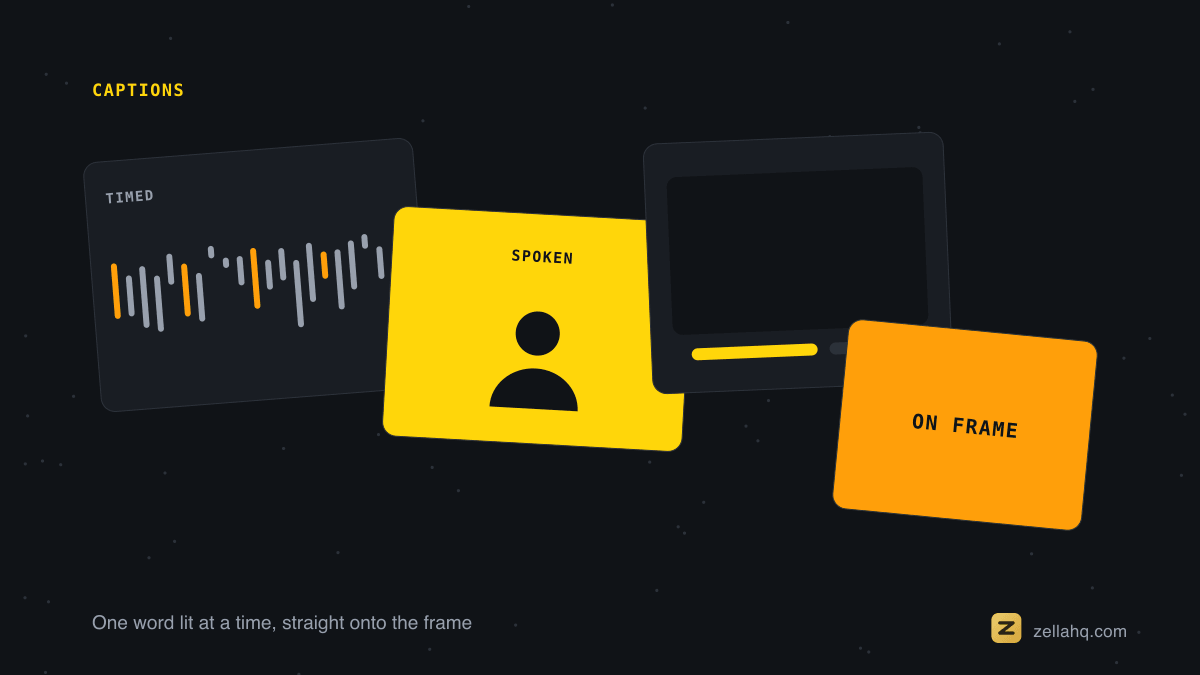
On a word-by-word caption style, that error is very visible. The highlight jumps to a word you have not said yet, or lags behind one you finished a beat ago. Viewers read that as sloppy even when every word is spelled right.
The fix: a second model that only does timing
Since 1.0.14, Zella runs two models, both on the device:
- The captions model (Standard, Best or Bangla) writes the words.
- Meta's MMS forced aligner, an open model that hears speech in more than 1,100 languages, listens again and moves each word onto the moment you say it.
Forced alignment is an old idea in speech research: when you already know the text, matching it to the audio is a much easier problem than recognising it from scratch. That is why a separate model does it well.
The one-time 300 MB download, and why
The aligner does not come inside the app. Zella fetches it once from its own server, models.zellahq.com. It is free on every plan.
| Mac | iPhone | |
|---|---|---|
| When it downloads | The first time you caption | Quietly in the background |
| Network | Any | Wi-Fi only |
| Size | about 300 MB | about 300 MB |
| Before it arrives | Estimated timing | Estimated timing |
On the Mac, that first caption run takes longer because of the download. After that, it is on your device and works offline like the rest of the caption engine. The download carries nothing from your project.
What changed in measured numbers
Zella's docs publish what the aligner did on the Bangla project whose field report started the work. The median gap between a caption word and where the full-size aligner places it fell from 1,525 ms to 9 ms, and the share of words within 150 ms went from 5% to 98%. Measured against the moments the voice actually starts after a pause, the median gap fell from 275 ms to 60 ms in Bangla and from 186 ms to 100 ms in English. Details are in caption languages and models.
How to get synced captions
On a Mac:
- Update to Zella 1.0.14 or later.
- Open your project and click the Captions tab.
- Set the Language and click Transcribe audio. The first run downloads the aligner.
- Pick a word-by-word style such as Word Pop or Karaoke on the Style tab and play it back.
On an iPhone:
- Update to Zella 1.0.14 or later.
- Join Wi-Fi and leave Zella open for a while so the aligner can download in the background.
- Tap Captions in the toolbar, check the Spoken language, and tap Generate captions.
If you captioned before the aligner arrived, caption again to get the aligned timing.
When captions still feel off
- Music over the voice. Where the aligner cannot hear a stretch clearly, that stretch keeps the estimated timing. Lower the music or caption before you add it.
- Chinese and Japanese. These are written without spaces, so a whole caption line is one unit. Only the start and end of each line are timed to your voice, not each word inside.
- The aligner download failed. Captions fall back to estimated timing. On iPhone, check that you are on Wi-Fi.
- A cut after captioning. Captions follow ripple deletes, Cut Empty Space and Remove Fillers, sliding earlier to stay on the right words. After any bigger rearrangement, play the video through once.
- The audio itself is late. If the whole video feels out of sync, not just the captions, the problem is the recording. Check that the voice matches the lips before you blame the captions.
How to check sync in thirty seconds
You do not need tools to judge caption timing. Your eyes and ears are enough:
- Pick a word-by-word preset such as Karaoke or Word Pop, where the active word is highlighted.
- Find a spot right after a pause, where you start speaking again. That is where guessed timing fails first.
- Play it with the sound on and watch the highlight. It should light up on the first syllable, not before you open your mouth.
- Check a fast stretch too. If the highlight keeps up there, the rest is almost certainly fine.
If the highlight leads or trails by a beat everywhere, the aligner probably has not run on that track yet. Caption again.
Common mistakes
- Captioning on iPhone right after install, on mobile data. The aligner waits for Wi-Fi. Until then you get estimated timing.
- Judging sync on a sentence-style preset. Clean Minimal shows whole sentences, so small timing errors hide. Check sync on a word-by-word style.
- Expecting per-character timing in Chinese. Line start and end are aligned; characters inside are not.
- Fixing timing by hand. You do not need to drag words around. Let the aligner run and caption again.
What it does not do
The aligner fixes timing, not spelling. A misheard word stays misheard until you fix it, as shown in how to fix wrong words in auto captions. It also does not upload your audio: both models run on the device. Read more about word timing in practice in word-by-word captions that retain, and see the captions and callouts features.
Resources and further reading
- Captions and subtitles in Zella: how transcription and word timing work on Mac and iPhone.
- Meta AI: Introducing speech-to-text, text-to-speech, and more for 1,100+ languages: the MMS project the aligner comes from.
- Forced alignment on Wikipedia: the technique in plain terms.
- WCAG: Understanding Captions (Prerecorded): why synchronised captions matter for accessibility.
Frequently asked questions
Why are my auto-generated captions out of sync? Most caption models write the words correctly but estimate when each word was said. Forced alignment fixes this by matching every word to your voice in a second pass.
What is the 300 MB download in Zella? It is Meta's MMS forced aligner, the model that times each caption word to your voice. It downloads once, free, from models.zellahq.com, and then works offline.
Do I need the aligner to make captions? No. Without it, captions still work, using estimated timing the way earlier versions did.
Why does the iPhone not download the aligner right away? The iPhone fetches it in the background on Wi-Fi only, so it does not use your mobile data. Join Wi-Fi and give it time.
Does the aligner work in every language? It works in every caption language. In Chinese and Japanese only the start and end of each line are timed to your voice, because those scripts have no spaces between words.
Written by
Nasir Uddin Shamim
Founder of Zella
Nasir Uddin Shamim is the founder of Zella. He built his career in SEO, AI, and marketing - never short on ideas, but every one of them hit the same wall: turning a raw recording into a video worth posting. Like most beginners, he burned hours fighting complicated editors and shipped far less than he wanted to. So he built Zella, a screen recorder and AI editor for Mac and iPhone that does the hard parts for you - first to unblock himself, and now to help anyone go from raw clip to polished video without the learning curve.
More from Zella: fresh tutorials on the channels above, plus product updates and editing tips straight to your inbox.
Make your next video with Zella.
Record, edit and ship on Mac and iPhone - local, private, free to start.
PART OF A SERIES
Fixing and styling auto captions
Wrong words, wrong language, bad timing and short-form caption looks.
- Why Are My Auto Captions Out of Sync? How to Fix Ityou are here
- How to Fix Wrong Words in Auto-Generated Captions
- How to Edit Caption Lines for Short-Form Video on Mac
- How to Make Hormozi-Style Captions on iPhone and Mac
- Auto Captions in the Wrong Language? Auto-Detect vs Picking
All of it lives under Captions & Callouts.
RELATED