Open the screen recording in Zella, open the AI Assistant and type the jobs in order: "remove the silences", "add zooms where I clicked", "blur the access token", "add captions" and "export in 1080p". Editing and text reading run on your device; only your typed message and a short project summary go to your AI provider.
On this page
An AI video editor for screen recordings should do the dull jobs every tutorial needs: cut the dead air, zoom in where you clicked, hide anything secret, add captions and resize for where you post. In Zella you do all of that by typing into the AI Assistant, on Mac or iPhone, and the editing and screen reading run on your device. The Assistant is free on every plan with your own free key.
This guide gives the prompts in the order that works, explains what each one does to a screen recording, and lists what still needs your eye.
Why screen recordings suit AI editing
A screen recording has a few problems that repeat every time. You pause to think. You say "um" while a page loads. The text is too small on a phone. A token or an email sits in a corner. None of these needs taste to fix; they need patience, which is what a chat-driven editor saves you.
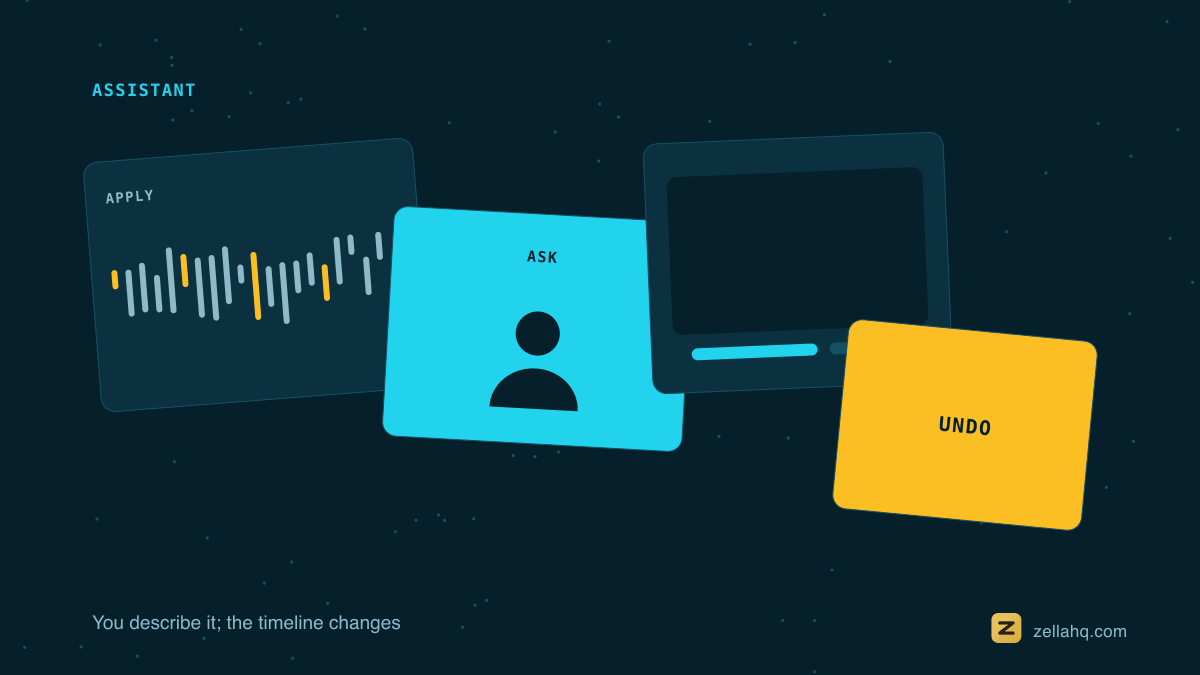
What AI does not fix is the recording itself. If the window was the wrong size or your microphone was muffled, the edit can only help so much. Record at a sensible size and with a decent mic, then let the Assistant do the rest.
The prompts, in the order that works
- "Remove the silent gaps." Cuts the pauses while you think or wait for a page. It tells you how many it found and asks before applying.
- "Cut out the ums and uhs." Removes filler words.
- "Add zooms where I clicked." On the Mac, Zella tracks your clicks while it records and zooms in on each one, the look viewers expect from a polished tutorial.
- "Blur the access token" or "blur every email." Reads the text on screen on your device and blurs each secret for as long as it shows, following it as the page scrolls.
- "Add captions in the Clean Minimal style." Writes your narration on screen, on your device.
- "Add an arrow pointing at the Settings button at 0:42." Places a callout where and when you say. "Where does the word Settings appear?" reads the screen first if you need the spot.
- "Clean up my voice." Removes hiss and hum and evens out the level.
- "Make it vertical for TikTok" if you are cutting a Short, or leave it wide for YouTube.
- "Export in 1080p." It asks before it creates the file. 1080p is free with no watermark.
Do the cuts first, then the zooms and blurs, then captions. Cutting after captions works too, but zooms and blurs placed before a cut are easier to check when the timeline has stopped moving.
What each step does to a screen recording
| Prompt | What changes | Mac | iPhone |
|---|---|---|---|
| Remove silences, fillers | Cuts dead air and ums | Yes | Yes |
| Zooms where I clicked | Zooms on tracked clicks | Yes | No cursor to track |
| Blur secrets | Blurs keys, tokens, emails on screen | Yes | Yes |
| Captions | On-device transcript on screen | Yes | Yes |
| Callouts at a time | Arrows, boxes, labels, keystrokes | Yes | Yes |
| What does the screen say | Reads on-screen text, masks secrets | Yes | Yes |
| Make vertical | 9:16 for Shorts, Reels, TikTok | Yes | Yes |
On iPhone you can screen record with the system's own recorder or with Zella's capture, then edit the same way. The click zooms are Mac only, because they come from the cursor Zella tracks while recording on the Mac.
Example: a three-minute tutorial, start to finish
Say you recorded a three-minute walkthrough of a settings page on your Mac. The chat might look like this:
- "Remove the silent gaps and the ums." The pauses go and the pacing tightens.
- "Add zooms where I clicked." Each click on a toggle or a button gets a zoom, so viewers on a phone can read it.
- "Blur the access token and every email." The token on the API page and your account email in the corner are covered for as long as they show.
- "Add captions in the Clean Minimal style, the video is in English." Narration appears on screen for viewers watching without sound.
- "Export in 1080p." Zella asks, you confirm, and the file lands in the Exports folder.
Five messages, one review pass, and a raw take becomes a tutorial you can post. Free exports run up to 2 minutes; a longer tutorial needs Zella Pro, which lifts the length cap.
One-tap and Claude alternatives
If you would rather not type each step, Auto-Polish runs a one-click pass: it cuts silences and fillers, adds an opening title and soft transitions, cleans the voice, lays a quiet music bed and adds a few zooms. Captions and blurs are separate requests afterwards. Our guide to going from a raw screen recording to ready to post in one tap covers it.
If you use Claude Code on a Mac and own Zella Founder, the Claude connector has a ready-made tutorial_polish edit: cut dead air, zoom to the action, hide secrets, add captions and a quiet bed, then look at the result. See how to connect Claude Code to Zella.
What still needs your eye
- Check every blur. Small, blurry, fast-scrolling or non-Latin text can be missed. Scrub before you export.
- Check the zooms land on the action. If a zoom lands somewhere unhelpful, remove it with "delete zoom 3" or soften it with "make zoom 3 weaker".
- Read the captions for product names. Speech models mishear brand and code names. Fix a line with "fix caption 3 to say...".
- Watch the first five seconds. The AI does not know your hook. Trim a slow start yourself.
Common mistakes
- Typing the secret into the chat. Ask it to blur "the API key"; never paste the key.
- Captioning before cutting a long silence. It works, but you re-check timing twice. Cut first.
- Expecting click zooms on imported footage. They need clicks Zella tracked while recording on the Mac.
- Leaving a leaked key active. A blur hides it from viewers of that file. If it was exposed, replace it with the service that issued it.
- Using a free AI key on a confidential call. The project summary can include caption text. See what leaves your device.
Resources and further reading
- The Zella AI Assistant: every command
- Cursor, clicks and keystrokes
- Take a screenshot or screen recording on Mac (Apple)
- Take a screen recording on iPhone (Apple)
More on recording on the capture feature page. For a full tutorial plan, see how to make a software tutorial video. Download Zella to record and edit in one app.
Frequently asked questions
Can AI edit a screen recording for me? Yes. In Zella you type jobs such as "remove the silences", "add zooms where I clicked" and "add captions" into the AI Assistant, and it makes the edits on your device.
Does the AI upload my screen recording? No. The editing and screen reading run on your Mac or iPhone. Only your typed message and a short project summary go to the AI provider whose key you added.
Can AI zoom in where I clicked? On the Mac, yes. Zella tracks your clicks while it records, and "add zooms where I clicked" zooms in on each one.
Can AI blur passwords in a screen recording? Yes. Type "blur the access token" or "blur the password", and Zella reads the screen on your device and blurs each one for as long as it shows.
Is the AI Assistant free for screen recordings? Yes. It is free on every Zella plan on Mac and iPhone. Free exports run up to 2 minutes at 1080p with no watermark; Pro lifts the length cap.
Written by
Nasir Uddin Shamim
Founder of Zella
Nasir Uddin Shamim is the founder of Zella. He built his career in SEO, AI, and marketing - never short on ideas, but every one of them hit the same wall: turning a raw recording into a video worth posting. Like most beginners, he burned hours fighting complicated editors and shipped far less than he wanted to. So he built Zella, a screen recorder and AI editor for Mac and iPhone that does the hard parts for you - first to unblock himself, and now to help anyone go from raw clip to polished video without the learning curve.
More from Zella: fresh tutorials on the channels above, plus product updates and editing tips straight to your inbox.
Make your next video with Zella.
Record, edit and ship on Mac and iPhone - local, private, free to start.
PART OF A SERIES
Let AI find, cut and blur
Search by spoken words, find best moments, blur emails, edit screen recordings.
- How to Search Your Videos by What Was Said
- How to Find the Best Moments in a Long Video for Shorts
- How to Blur an Email Address or Name in a Video
- AI Video Editor for Screen Recordings: What to Ask Ityou are here
- AI Captions in the Wrong Language? Tell It What Is Spoken
All of it lives under One-Click.
RELATED