Add captions, then run Auto B-Roll: on Mac click Add B-Roll and choose Cancel at the key prompt, on iPhone tap Auto, then Add generated cutaway cards (no key). Zella picks the most visual word per caption line on-device and drops a designed keyword card for it. No key, no account, no network, free on every plan.
On this page
- What keyword cards are, and are not
- Step 1: add captions
- Step 2 on Mac: run Add B-Roll with no key
- Step 2 on iPhone
- How long the cards are, and how often
- Trim, move or remove a card
- When to add the optional free key
- Common mistakes
- Talking head or screen recording?
- Resources and further reading
- Frequently asked questions
You can add b-roll to a talking video without signing up for a stock site or pasting an API key. Zella's Auto B-Roll reads your captions, picks the most visual word in each line on your device, and drops a designed keyword card for it as a full-frame cutaway. Nothing goes online, and it is free on every plan, on Mac and iPhone.
This guide covers the keyless path step by step, what the cards look like and how often they appear, and when the optional free stock key is worth adding. If you are new to the term, what b-roll is explains it. Zella is free from the download page.
What keyword cards are, and are not
A keyword card is a dark gradient card with one word set on it, for example "budget" or "coffee", placed over your video when you say that word. It gives the viewer a break from your face and underlines the point of the line.
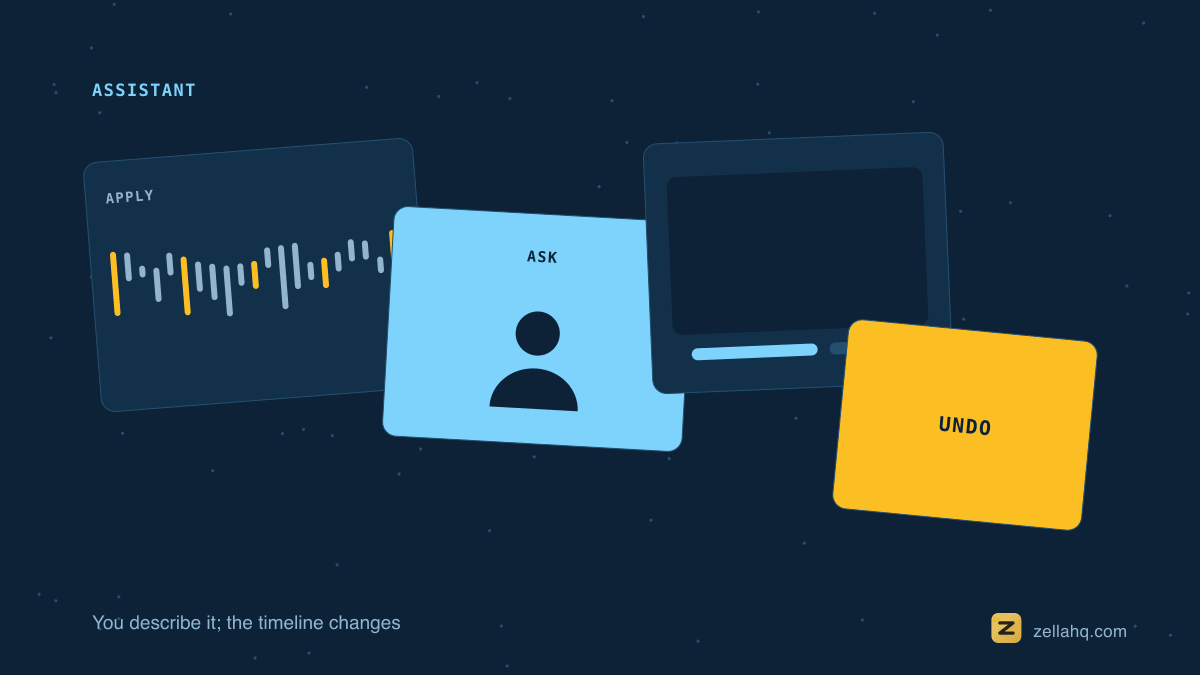
What it is not: filmed footage. The cards are typography that Zella draws itself. That is why they need no licence, no key and no network. Zella labels them as keyword cards in the status line, so you never mistake them for stock.
Step 1: add captions
Auto B-Roll works from captions, so they must exist first.
- Mac: open the Captions tab and click Transcribe audio, or click Enable Captions in the Auto Tools sidebar.
- iPhone: tap Captions, or run Make it Viral, which captions as part of its pass.
Transcription runs on-device. Fix any misheard names before the next step, since the keyword comes from the text.
Step 2 on Mac: run Add B-Roll with no key
- In the left sidebar, open Auto and click Add B-Roll in the OFTEN group.
- If you have never saved a stock key, Zella asks for one, with Save, Get a free key, Use Pixabay instead and Cancel.
- Click Cancel. This is the keyless path, not an error.
- Zella reads each caption line, picks the most visual keyword with Apple's on-device NaturalLanguage framework, draws a card for it and places it on the timeline.
- Play the video. Click Add B-Roll again if you want to remove every card it placed.
With one clip selected on the Mac, only that clip gets cards.
Step 2 on iPhone
- Tap Auto at the top of the editor.
- Scroll to Auto B-Roll.
- Tap Add generated cutaway cards (no key).
- Zella generates a cutaway card per keyword and drops each one near the line that mentions it.
The whole run is on-device on the phone too. There is nothing to sign up for.
How long the cards are, and how often
| Keyword cards | Optional stock clips | |
|---|---|---|
| Length each | About 2.5 seconds | Up to about 4 seconds |
| How often | About one every 9 seconds | About one every 7 seconds |
| Per pass | 2 to 8 | Up to 14 |
| Sound | None | Muted, so your voice plays on |
| Frame | Full-frame cutaway | Full-frame cutaway |
| Needs | Nothing | A free Pexels or Pixabay key and a connection |
The cards are spaced across the whole video, tied to the lines with the most visual words, rather than dropped every few seconds by a timer.
Trim, move or remove a card
Every card lands as an ordinary overlay, so you keep full control:
- Move it earlier or later so it lands on the exact word.
- Trim its edges for a shorter or longer cutaway.
- Delete it like any overlay, and your footage plays through.
- Replace it with your own clip in the same spot.
Treat the pass as a first draft: run it, then fix the two or three cards that land on a weak word.
When to add the optional free key
Keyword cards carry the point of a line. If you want actual filmed shots of a city or a laptop, add a free key from Pexels or Pixabay. On Mac, paste it at the prompt and click Save; on iPhone, open Connect Pexels / Pixabay (free). The key is stored in your Keychain.
On that path, only the keyword is sent to the stock provider to search. Your video never leaves the device. Read each provider's licence before commercial use. The keyless cards involve no provider at all. Automatic b-roll for videos compares both paths in more depth.
Common mistakes
- Running it before captions. No captions means no words to read, so nothing is placed.
- Thinking Cancel failed. On Mac, Cancel at the key prompt is how you choose keyword cards.
- Covering a demo. Cards are full-frame. Over a screen recording they hide the screen for 2.5 seconds; move or delete any that land on a step the viewer needs to see.
- Keeping every card. A card on a filler word looks random. Delete it.
- Mistranscribed keywords. A misheard word becomes a card with the wrong word. Fix the caption first.
Talking head or screen recording?
Keyword cards behave differently depending on what is underneath them.
- Talking-head videos are where they shine. Your face is on screen the whole time, so a 2.5-second card every so often is a welcome change, and the word reinforces what you just said.
- Screen recordings and tutorials need more care. The card covers the whole frame, including the screen the viewer is following. Run Auto B-Roll, then delete any card that lands on a step, and keep the ones over intros, summaries and transitions between sections.
- Short vertical reels can take a card on most strong lines. Pair them with word-by-word captions for a fast, busy feel.
If only one part of the video needs cutaways, select that clip on the Mac before you click Add B-Roll. Only that clip gets cards, and the rest of the video stays clean.
Resources and further reading
- Auto B-Roll in Zella, with the Mac and iPhone comparison table.
- Captions, since the cards come from your caption lines.
- Apple NaturalLanguage framework, the on-device text analysis that picks the keyword.
- B-roll on Wikipedia, for the origin of the term.
- Sibling guide: how to add b-roll to a talking head video.
Frequently asked questions
Can I add b-roll without stock footage? Yes. Zella's Auto B-Roll makes designed keyword cards on your device from your captions, so you need no stock site at all.
Do I need an API key for Auto B-Roll? No, on Mac or iPhone. A free Pexels or Pixabay key is only for the optional path that fetches filmed stock clips.
Does Auto B-Roll upload my video? No. Keyword cards are made entirely on your device. With the optional stock key, only one keyword per line is sent to search.
Is Auto B-Roll free? Yes. It is free on every plan, on both platforms, like all of Zella's AI.
Why did Auto B-Roll place nothing? It reads captions, so the video needs captions first. Transcribe, then run it again.
Written by
Nasir Uddin Shamim
Founder of Zella
Nasir Uddin Shamim is the founder of Zella. He built his career in SEO, AI, and marketing - never short on ideas, but every one of them hit the same wall: turning a raw recording into a video worth posting. Like most beginners, he burned hours fighting complicated editors and shipped far less than he wanted to. So he built Zella, a screen recorder and AI editor for Mac and iPhone that does the hard parts for you - first to unblock himself, and now to help anyone go from raw clip to polished video without the learning curve.
More from Zella: fresh tutorials on the channels above, plus product updates and editing tips straight to your inbox.
Make your next video with Zella.
Record, edit and ship on Mac and iPhone - local, private, free to start.
PART OF A SERIES
Editing by words, transitions and b-roll
Cut from the transcript, pick transitions, add b-roll with no key, protect recordings.
- How to Edit a Video by Deleting Words From the Transcript
- Types of Video Transitions Explained: All 25 in Zella
- How to Add B-Roll Without Stock Footage or an API Keyyou are here
- How to Find and Organize Your Screen Recordings on Mac
- What Happens to Your Recording if Your Mac Crashes?
All of it lives under Pro Editor.
RELATED