Background removal gives a cleaner edge when you are well lit from the front, stand a little away from the wall, wear something that contrasts with it, and keep fast gestures to a minimum. Then remove the background in the editor: Remove Background in the Mac Background tab, or Remove background under Auto tools on iPhone.
On this page
The cleanest AI background removal starts before you press record. Light yourself well from the front, stand a little away from the wall, wear something that contrasts with what is behind you, and keep fast hand movements for the moments that need them. Then remove the background in the editor, where you can change your mind as often as you like.
This guide covers the setup choices that help any person-segmentation model, then the steps in Zella's background tools on Mac and iPhone. If your cutout already looks rough on moving shots, read why background removal looks bad when you move first.
Why setup matters to the cutout
Background removal without a green screen works by recognising a person in each frame and separating them from everything else. It is good at this, but it has to make decisions at the edge: is that pixel hair or wall? Shoulder or shadow?
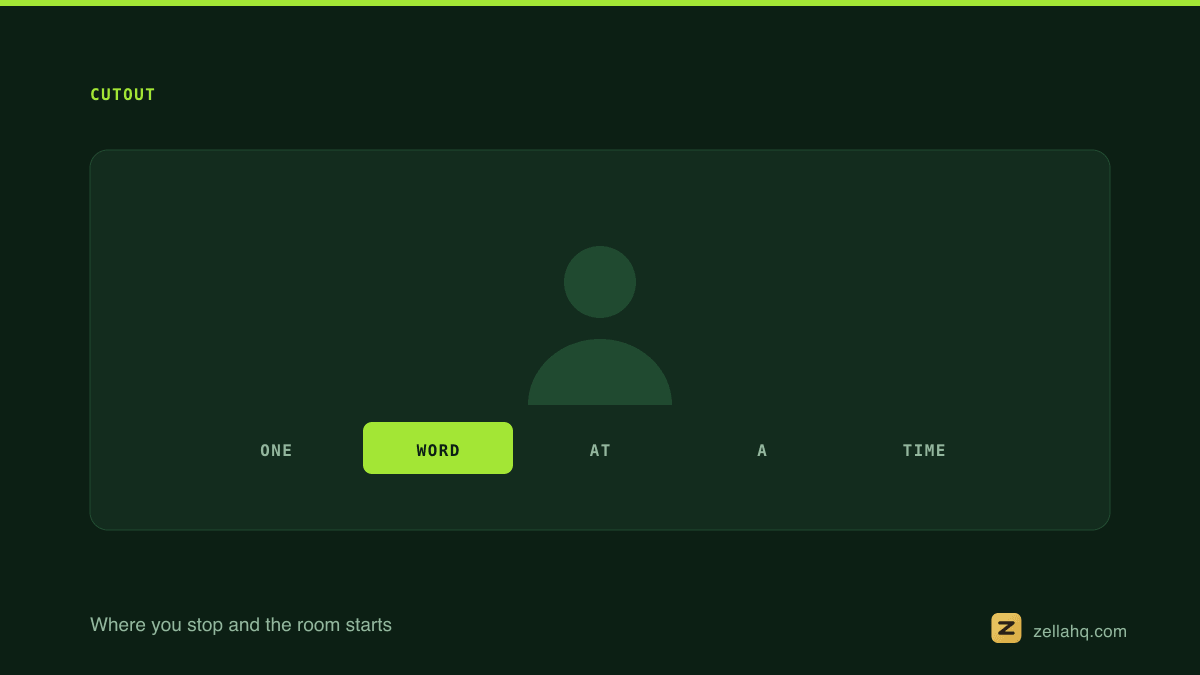
Every setup choice below makes that decision easier. None of them is required. Each one gives the model a clearer edge to find.
The setup checklist
- Light from the front. A lamp or window in front of you, slightly to one side. Avoid a bright window behind you.
- Separate from the wall. Sit or stand a metre or so in front of it, so you do not merge with your own shadow.
- Contrast with the background. Dark clothes against a light wall, or the reverse. A grey jumper on a grey wall is the hardest case.
- Plain behind you if you can. Fewer objects near your outline means fewer edge decisions.
- Keep hair tidy at the edge. Fine flyaway strands are the hardest thing to cut out cleanly.
- Frame with room. Leave space around your head and shoulders so the edge is not touching the frame.
- Steady camera. A tripod or a stable surface keeps the edge consistent from frame to frame.
Movement and motion blur
Fast movement is the hardest case for any cutout. When your hand moves quickly, the camera records a blur: the wall colour and your skin colour physically mix in the same pixels. No model can fully un-mix them.
On iPhone, Zella's matte handles this by trimming those blurred pixels along a moving arm instead of trying to recolour them, while still parts of the frame keep every strand of hair. Every frame is matted by Apple's person segmentation and its person-instance detector, and only what both accept survives, which stops either model briefly pulling a chunk of the room into you. On export, the thin shell around your silhouette takes its colour from you rather than the room.
What you can do while filming:
- More light means less blur. In a bright room, the camera uses a faster shutter, so moving hands smear less.
- Gesture with intent. A deliberate gesture held for a beat cuts out better than constant fast waving.
- Keep hands inside your outline when you can, rather than sweeping out past the frame edge.
How to remove your background in Zella
You do this after recording. Zella records your real camera picture, so the original is always there.
On the Mac:
- Open the recording in the editor and click Background in the left sidebar.
- Click Remove Background at the top. It cuts you out with on-device AI; nothing uploads.
- Pick a look: Pop keeps you sharp over your own softened room, Blur gives a portrait-mode look, Cutout removes the room, or choose a solid colour, one of 20 still backdrops or 20 animated ones.
- If an edge looks wrong, use Re-process in the same Background tab.
- For separation on a new backdrop, click Studio Glow under FINISHING TOUCHES for a backlight and contact shadow.
On iPhone:
- Open the project and tap Auto tools, then Background, then Remove background to do every clip at once.
- You land on a soft bokeh backdrop. To change it on one clip, open Effects, then BG, and pick None, Blur, Cutout, Color, Image or Preset.
- Play a moving section and check the edge around your hands and hair.
Removing the background runs once per clip on the graphics chip. On an Intel Mac it can be slower.
Choosing a backdrop that hides edge flaws
Some backdrops are more forgiving than others.
| Backdrop | Forgiving? | Why |
|---|---|---|
| Blur or Pop | Very | Your real room is still there, so small edge errors blend in |
| Soft bokeh or dark backdrops | Quite | Low detail hides a slightly soft edge |
| Busy or bright images | Less | Strong contrast shows every edge decision |
| Plain white | Least | Any rim of the old room shows against white |
If your footage has lots of movement, Blur or Pop is the safe choice. Once the cutout is clean, the colour looks and effects in Zella's effects tools grade you and the new backdrop together. For more on making a replacement convincing, see how to make a replaced background look real.
Test before the real take
Record ten seconds in your setup, wave a hand once, and remove the background on that test clip before you film the real thing. It takes a minute and tells you whether the light, the distance and your clothes are working, while you can still change them.
Common mistakes
- A window behind you. You become a silhouette, and the edge has nothing to work with.
- Matching your clothes to the wall. The model has to guess where you end.
- Sitting against the wall. Your shadow joins your outline and gets cut in with you.
- Choosing pure white on a moving shot. Every edge decision shows.
- Expecting perfect hands in fast motion. Motion blur mixes colours in the pixels. Slow the gesture or use Blur.
Resources and further reading
- Camera and backgrounds in Zella: Remove Background, the four tabs, and how the cutout holds up when you move.
- Person segmentation in Apple Vision: the Apple framework behind on-device person cutouts.
- Three-point lighting: the classic setup for lighting a subject so they separate from the background.
Frequently asked questions
How do I get a clean background removal without a green screen? Light yourself from the front, sit a little away from the wall, wear clothes that contrast with it and keep fast gestures to a minimum. Then remove the background in the editor and pick a forgiving backdrop such as Blur.
Why do my hands disappear in background removal? Fast movement creates motion blur that mixes your skin with the wall colour. On iPhone, Zella trims those pixels rather than guess. More light and slower gestures reduce it.
Does Zella upload my video to remove the background? No. Background removal runs on your Mac or iPhone with on-device AI. Nothing is uploaded.
Can I change the background after recording? Yes. Zella records your real camera picture, and you blur, remove or replace the background in the editor afterwards, as often as you like. The original stays intact.
What backdrop hides cutout mistakes best? Blur or Pop, because your real room stays in the picture and small edge errors blend in. Plain white backdrops show edge flaws the most.
Download Zella for Mac or iPhone and try Remove Background on your next take.
Written by
Nasir Uddin Shamim
Founder of Zella
Nasir Uddin Shamim is the founder of Zella. He built his career in SEO, AI, and marketing - never short on ideas, but every one of them hit the same wall: turning a raw recording into a video worth posting. Like most beginners, he burned hours fighting complicated editors and shipped far less than he wanted to. So he built Zella, a screen recorder and AI editor for Mac and iPhone that does the hard parts for you - first to unblock himself, and now to help anyone go from raw clip to polished video without the learning curve.
More from Zella: fresh tutorials on the channels above, plus product updates and editing tips straight to your inbox.
Make your next video with Zella.
Record, edit and ship on Mac and iPhone - local, private, free to start.
PART OF A SERIES
Film looks and finishing effects
Film look, letterbox, glow, blend modes and clean background removal.
- How to Make Digital Video Look Like Film
- How to Add Cinematic Black Bars to a Video (Letterbox)
- How to Add a Glow Effect to a Video on Mac and iPhone
- Video Blend Modes Explained: Screen, Multiply and Overlay
- How to Film Yourself for Clean Background Removalyou are here
All of it lives under Effects & Color.
RELATED