Digital video looks like film when you change four things: a softer tone curve, film-style colour, a little grain, and a widescreen frame. In Zella that means a Film look such as Kodak 2383 or Portra 400 at about half strength, light Film Grain, and the Letterbox 2.35:1 switch if the shot suits it.
On this page
Digital video starts to look like film when you change four things together: the tone, the colour, the texture and the frame. A film-style look handles tone and colour, a little grain handles texture, and letterbox bars handle the frame. No single filter does all four, and pushing any one of them too far gives the game away.
Here is how to build that look in Zella on Mac or iPhone, using looks that already exist in the catalogue rather than a pile of manual settings.
What makes footage read as film
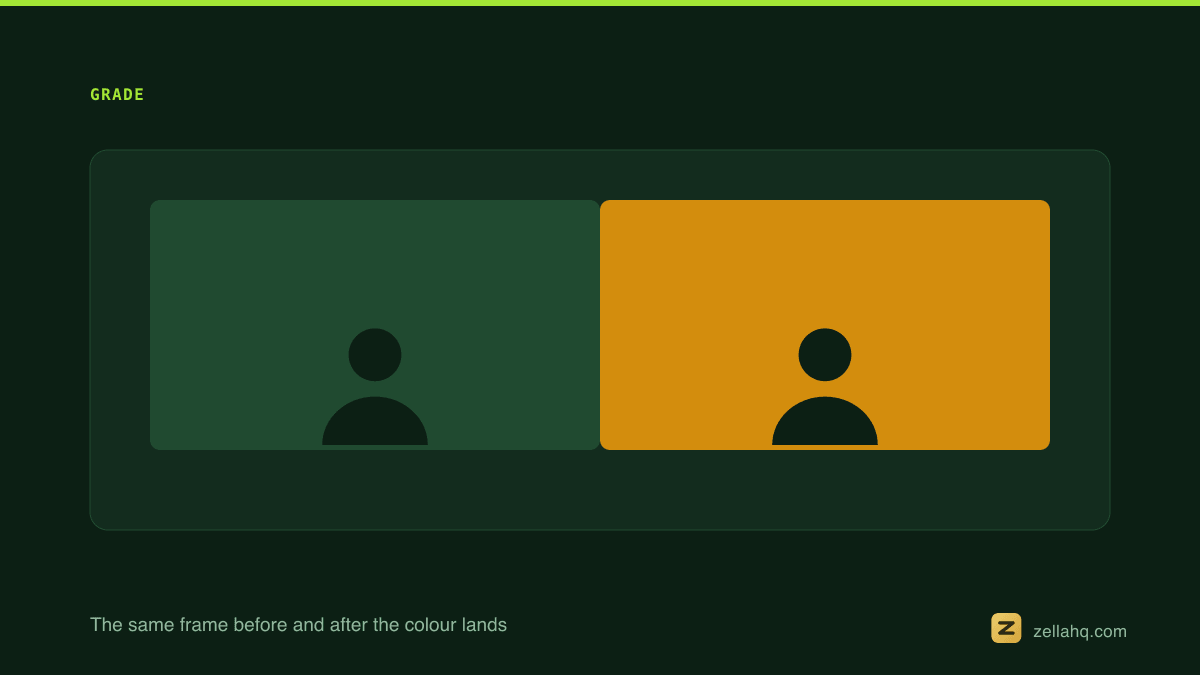
Phone and webcam video is sharp, clean and often contrasty in a harsh way. Film footage tends to differ in four ways:
| Element | Digital default | Film-style |
|---|---|---|
| Tone | Hard highlights, deep shadows | Softer highlights, lifted or gentle shadows |
| Colour | Accurate, sometimes cold | Warmer skin, shifted greens and blues |
| Texture | Perfectly clean | Fine, moving grain |
| Frame | 16:9 or 9:16 | Often wider, with black bars |
You do not need all four on every shot. Tone and colour carry most of the effect. Grain and bars are seasoning.
Pick a film-style look
Zella's catalogue has a Film family and a Vintage family, and the Look Library added in October 2026 brought film stocks among its 50 original looks. Looks worth trying first:
- Kodak 2383: the print-film look, rich and slightly warm. It is a free look, separate from the Founder look named Founder Kodak.
- Portra 400: soft, warm skin and gentle highlights.
- Fuji Natural: cleaner, cooler greens.
- Kodachrome: saturated, punchy colour.
- Retro Halation: 70s-print warmth with glowing highlights and a whisper of grain.
- Golden Hour: warm, low-sun light, for footage that wants that late afternoon feel.
Golden Hour and Portra 400 were retuned in Mac 1.0.5 and iPhone 1.0.6 so they hold their highlights on bright footage instead of blowing them out. That matters most for film looks, because a warm look on an already bright shot is where highlights usually go first.
How to build a film look in Zella
- Finish your cut first. Grade once the edit is locked.
- Open the Effects tab (on iPhone, Effects, then Looks).
- On the Mac, click the Film family chip. Click Kodak 2383 or Portra 400.
- Pull Look Intensity down to about 50 percent. Film looks lose their charm at full strength.
- In the effects list, add Film Grain and keep its slider low. On iPhone the slider is called Grain, under Effects, Effects.
- If the shot is a wide scene or an intro, turn on Letterbox 2.35:1 for widescreen bars.
- Play it at full size and on a phone. Grain that looks right on a big screen can disappear on a small one, and the reverse.
For the grain and vignette controls in more detail, see how to add a vignette and film grain to a video.
Getting a Golden Hour look on footage that was not shot at golden hour
Real golden hour light comes from a low sun: warm, soft and from the side. A look can warm the colour, but it cannot move the shadows. So it works best on footage that already has soft, directional light.
- Works well: outdoor footage shot in open shade, window-lit interiors, overcast exteriors.
- Works less well: harsh midday sun with hard overhead shadows, or a flat front-lit webcam picture.
If you can plan the shoot, film in the hour after sunrise or before sunset and let the look finish the job. Because every Zella look protects skin tones, a warm look will not turn a face orange, but the room around you will still warm up.
Film look for a reel versus a long video
The same recipe needs different strengths depending on where the video will play.
| Short reel on a phone | Long video on a big screen | |
|---|---|---|
| Look Intensity | Around 60 percent, a little bolder | Around 40 to 50 percent |
| Grain | Slightly more, small screens hide it | Less, it shows on a large display |
| Letterbox | Openers only, the frame is already tall | Wide scenes and chapter openers |
| Shadows | Keep detail, phones are often viewed outdoors | Can sit a little deeper |
Short-form rewards a clear style in the first seconds, so a slightly stronger look is fine there. A long video is watched for minutes, and a heavy look becomes tiring. Whichever you make, play the export on the device most of your viewers will use before you post. If the grain disappears on a phone, raise it a touch; if faces look muddy on a laptop, lower Look Intensity.
When not to use a film look
A film look is a style. It says "this is a mood piece". That suits intros, travel videos, short films, music edits and brand stories. It suits tutorials and screen recordings far less, because grain and lifted shadows make small text harder to read. On a tutorial, keep the grade light and the grain off.
Common mistakes
- Too much grain. Grain should be felt, not seen. If you notice it first, halve it.
- Full-strength looks. Real film is subtle. Around 40 to 60 percent usually reads more like film than 100.
- Letterbox on everything. Bars suit wide scenes and openers. On a talking head they cut into the frame for no reason. See how to add cinematic black bars to a video.
- Mixing film stocks between clips. Pick one look for the whole piece so it feels shot on one stock.
- Expecting a look to fix bad light. It colours light; it does not move it.
Resources and further reading
- Color grading and looks in Zella: the Film family, the Look Library and Look Intensity.
- Effects in Zella: Film Grain, Vignette and Letterbox 2.35:1.
- Film grain: what grain is and why it moves.
- Golden hour: when it happens and why the light looks the way it does.
Frequently asked questions
What is the best look for a film effect in Zella? Kodak 2383 and Portra 400 in the Film family are good starting points. Set Look Intensity to about half and add a little Film Grain.
Does Zella have a Golden Hour filter? Yes. Golden Hour is one of the free looks on Mac and iPhone, and since Mac 1.0.5 and iPhone 1.0.6 it holds its highlights on bright footage.
How do I add film grain to a video? Open the Effects tab and add Film Grain, or Grain on iPhone, then keep the slider low. Grain bakes into the export.
Is Kodak 2383 the same as Founder Kodak? No. Kodak 2383 is a free look that exports on every plan. Founder Kodak is one of the 7 Founder looks, which anyone can preview and which needs Zella Founder to export.
Does a film look work on screen recordings? Usually not well. Grain and lifted shadows reduce the contrast of small text, so tutorials are better with a light, clean grade.
Want to try Kodak 2383 on your own footage? Download Zella for Mac or iPhone.
Written by
Nasir Uddin Shamim
Founder of Zella
Nasir Uddin Shamim is the founder of Zella. He built his career in SEO, AI, and marketing - never short on ideas, but every one of them hit the same wall: turning a raw recording into a video worth posting. Like most beginners, he burned hours fighting complicated editors and shipped far less than he wanted to. So he built Zella, a screen recorder and AI editor for Mac and iPhone that does the hard parts for you - first to unblock himself, and now to help anyone go from raw clip to polished video without the learning curve.
More from Zella: fresh tutorials on the channels above, plus product updates and editing tips straight to your inbox.
Make your next video with Zella.
Record, edit and ship on Mac and iPhone - local, private, free to start.
PART OF A SERIES
Film looks and finishing effects
Film look, letterbox, glow, blend modes and clean background removal.
- How to Make Digital Video Look Like Filmyou are here
- How to Add Cinematic Black Bars to a Video (Letterbox)
- How to Add a Glow Effect to a Video on Mac and iPhone
- Video Blend Modes Explained: Screen, Multiply and Overlay
- How to Film Yourself for Clean Background Removal
All of it lives under Effects & Color.
RELATED