A hook is the first 1 to 3 seconds of a short-form video, and it decides whether the rest gets watched. The strongest 2026 hooks land in 10 to 14 words and stack two triggers at once, such as a curiosity gap plus a bold claim. Below are 10 copy-ready formulas, and the three edits that make one land: cut the dead air, put the line on screen, open on a zoom.
A hook is the first 1 to 3 seconds of your video, and it is the most important edit you will make. Survey figures put around 71 percent of viewers deciding within the first few seconds whether to keep watching, and the three-second hold is generally treated as the first checkpoint that matters. Both are third-party numbers rather than platform ones. The advice that recurs across hook analyses is 10 to 14 words, stacking two psychological triggers at once. No platform publishes anything on hook length, so this is pattern-matching by people who write a lot of them. This guide gives you 10 proven formulas with example lines, then shows how to edit the hook so it actually lands.
Why do the first 3 seconds matter so much?
The math is unforgiving. If viewers scroll past in the first three seconds, watch time and completion rate collapse, and those are the strongest ranking signals on TikTok, Reels, and Shorts. Videos holding 60 percent or more of viewers past three seconds are reported to travel further, though the exact cut-off moves with whoever measured it. Analyses of large samples of viral videos find the great majority open with an explicit hook inside three seconds. Third-party work, not platform data - but consistent across everyone who has counted.
Key terms:
- Pattern interrupt is anything that breaks the expected scroll, an unexpected visual, sound, or claim.
- Curiosity gap is an open loop the viewer needs to close, so they stay to get the answer.
- Social proof is a signal that other people care, results, numbers, or "everyone is doing this."
The commonly-given advice is to combine at least two of these three triggers in the first three seconds.
What are the best hook formulas for 2026?
The three formulas that come up most often in hook breakdowns are the contrarian claim, the mistake warning, and the list tease, because each stacks curiosity, self-relevance and a clear promise into one sentence. Here are 10 you can copy and adapt today.
| # | Hook formula | Example line | Triggers |
|---|---|---|---|
| 1 | Contrarian claim | "Most people get this completely wrong about email." | Pattern interrupt + curiosity |
| 2 | Mistake warning | "Stop doing this if you want your Reels to grow." | Self-relevance + curiosity |
| 3 | List tease | "Three settings I wish I knew before I started editing." | Promise + curiosity |
| 4 | Curiosity gap | "Here's what nobody tells you about going viral." | Curiosity + social proof |
| 5 | Bold declarative | "This one edit doubled my watch time." | Pattern interrupt + proof |
| 6 | Direct question | "Why is your screen recording putting people to sleep?" | Self-relevance + curiosity |
| 7 | Before / after | "This is my footage. This is it after one click." | Visual + proof |
| 8 | Callout by group | "If you make videos on a Mac, watch this." | Self-relevance |
| 9 | Result-first | "I got 40,000 views on my first try. Here's how." | Social proof + promise |
| 10 | Negativity bias | "The mistake that is quietly killing your reach." | Curiosity + self-relevance |
Top-performing sentence starters in 2026 include "Most people get this wrong about...", "Stop doing X if you want Y", and "Here's what nobody tells you about...".
How do you write a hook that works?
Follow four rules drawn from what the data rewards:
- Front-load the payoff. Say the most interesting thing first. The reveal can wait; the reason to stay cannot.
- Keep it to 10 to 14 words. That is roughly what fits inside three seconds of speech, which is the real constraint behind the number.
- Stack two triggers. Pair a bold claim with proof, or a question with self-relevance. One trigger is forgettable; two stop the scroll.
- Establish credibility on the second beat. Lead with the claim, then in the next frame show the receipt, for example "Most creators are killing their reach with captions," followed by the proof (OpusClip).
Avoid slow warm-ups ("Hey guys, so today I wanted to talk about..."), throat-clearing, and logos. Every one of those burns your three seconds.
How do you edit the hook itself?
Great hook copy still fails if the editing is soft. The words are half the job; the cut, the text, and the zoom are the other half.
- Cut the dead air first. Delete the pause, breath, and any false start before your opening line so the hook is the literal first frame of speech. On a Mac, Zella does this in one pass: its one-click cleanup removes silences and filler words automatically, so your first spoken word lands instantly. See how to remove filler words from a video on Mac.
- Add on-screen text for the hook line. Most people watch on autoplay with sound off, so put your hook on screen as bold text in the first frame. Zella ships 9 on-device caption presets with active-word highlighting, plus a full-screen intro card if you want the hook to own the frame. See how to automatically caption a video on Mac.
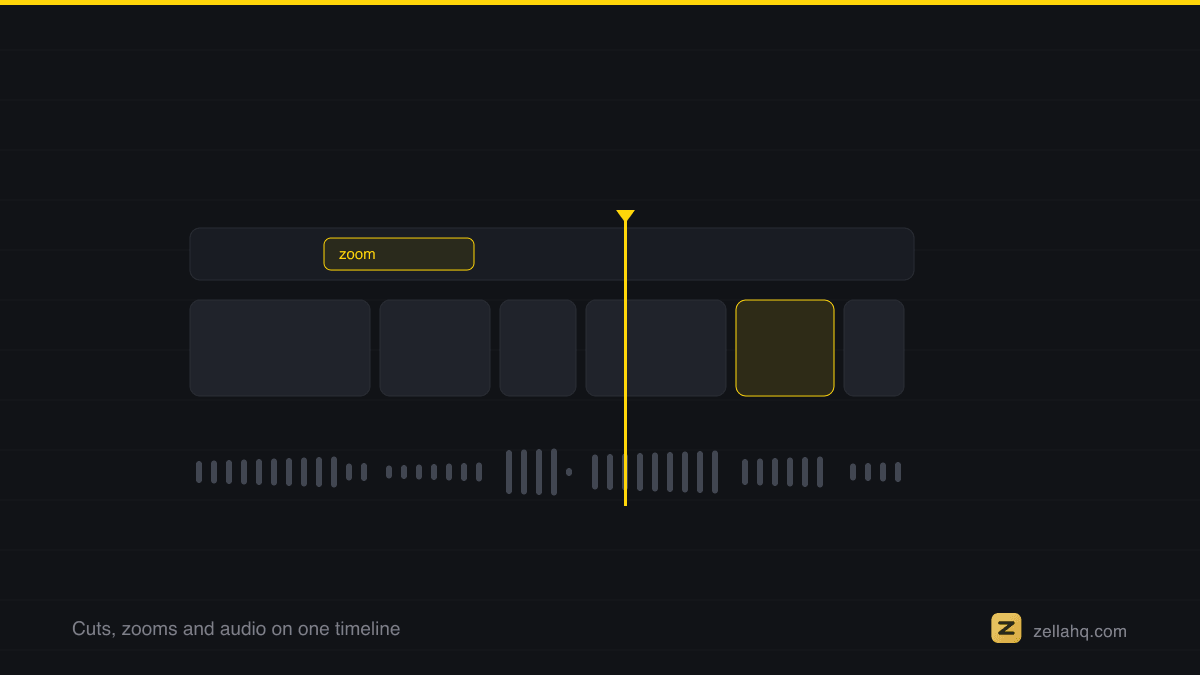
- Open on a punch-in or fast cut. A zoom or a hard cut on the first word is a pattern interrupt that resets attention. Zella can auto-zoom on your clicks for screen recordings, or you can add manual zooms and speed ramps in the editor.
- Show the "after," not the setup. If you have a before/after, lead with the finished result, then rewind to how you got there. That is the delayed-reveal pattern working from frame one.
If you would rather describe the edit than click it, Zella's AI Assistant takes plain-English instructions like "trim the first two seconds and zoom in on the first word." It is free on every platform, runs on your own API key, and only the sentence you type ever leaves the device. Your footage never does.
Hook writing checklist
Before you lock your edit, confirm:
- The hook is 10 to 14 words and the payoff is front-loaded.
- It stacks at least two triggers (pattern interrupt, curiosity gap, social proof).
- The first frame is your first spoken word, no dead air.
- The hook line is on screen as bold text for sound-off viewers.
- There is a zoom or hard cut on the opening beat.
- Credibility or proof arrives on the second beat.
Frequently asked questions
How long should a hook be? Aim for 10 to 14 words delivered inside the first three seconds - about as much as fits in that window at a natural speaking pace.
What is the single best hook formula? There is no universal winner. The contrarian claim, the mistake warning and the list tease recur most often in hook breakdowns, because each stacks curiosity, self-relevance and a promise into one line.
Do hooks need on-screen text? Yes, in practice. Most feeds autoplay muted, so putting the hook line on screen as text captures viewers who never turn sound on. On-device captions make this a one-click step.
Why does my video with a good hook still not perform? A hook only buys the next few seconds. If retention drops after that because of slow pacing or filler, the algorithm stops pushing it. See our guide on how to make a video go viral for the full retention picture.
Can editing really change how a hook performs? Yes. Cutting dead air so your first word is the first frame, adding hook text, and opening on a zoom or cut all measurably improve the three-second hold. Zella's Auto-Polish handles the cutting and zooms in one click on its free plan, and captions are one more; see pricing.
Make your next video with Zella.
Record, edit and ship on Mac and iPhone - local, private, free to start.
RELATED