In 2026, aim for 21 to 34 seconds on TikTok, 7 to 30 seconds on Instagram Reels, and 25 to 45 seconds on YouTube Shorts. Length is a guideline, not a rule: every platform ranks on completion rate, the share of viewers who watch to the end. A tight 20-second clip watched fully beats a 3-minute clip people abandon at 0:45.
The short answer: for maximum reach in 2026, keep TikToks around 21 to 34 seconds, Instagram Reels between 7 and 30 seconds, and YouTube Shorts in the 25 to 45 second range. Those windows have the best mix of storytelling room and completion rate. But length is only a proxy for the metric that actually decides your reach: retention. Every major short-form algorithm now ranks on how much of your video people watch, so the real goal is a clip short enough that most viewers finish it.
What is the ideal length for each platform in 2026?
Here is the current data-backed sweet spot per platform, plus the technical maximum you are allowed to post.
| Platform | Ideal length (2026) | Best for reach | Maximum length |
|---|---|---|---|
| TikTok | 21 to 34 seconds | 11 to 18 seconds | 60 minutes (uploaded) |
| Instagram Reels | 7 to 30 seconds | 7 to 15 seconds | 3 minutes in-app; 15 minutes uploaded |
| YouTube Shorts | 25 to 45 seconds | 15 to 30 seconds | 3 minutes |
On TikTok, one in four of the most-liked videos falls in the 21 to 34 second range, while clips of 11 to 18 seconds tend to go viral fastest because they are easy to finish and replay. On Instagram, short Reels are reported to earn substantially more replays than Reels over a minute, with the 15-to-30-second band showing the strongest average engagement. Meta publishes none of this, so the figures come from third-party analyses of public posts. On YouTube, creator-community analyses put many viral Shorts between 25 and 35 seconds, with the broader sweet spot at 30 to 45. YouTube itself publishes no ideal length - what it describes weighing is how much of the video people watch, which is a ratio, not a duration.
Why does retention matter more than length?
Because the algorithm does not reward long videos - it rewards videos people finish. On TikTok the working assumption is that a three-minute video people abandon at 45 seconds does worse than a 20-second video watched to the end. "Penalises" overstates what anyone can actually observe - what is visible is that completion tracks with reach. Instagram is generally believed to weight completion rate most heavily for Reels, though again this is inference from behaviour rather than anything Meta has documented. YouTube says its recommendation system learns from how long and how much of a video people watch and whether they positively engage with it - runtime itself is not on the list.
Key term - completion rate: the percentage of viewers who watch your video all the way to the end. A 90 percent completion rate on a 20-second clip is a stronger signal than a 40 percent completion rate on a 60-second one, even though the longer clip logs more total seconds.
The data makes the tradeoff concrete. Third-party samples put completion at roughly 90 percent for videos under 15 seconds, mid-80s for 16-to-30-second clips, and closer to two-thirds once you pass half a minute. The exact percentages vary by whoever measured them; the slope is the point. Every second you add is a second more of the clip people can bail on. So the practical rule is: make the video exactly as long as the idea needs, and not one beat longer.
Does content type change the ideal length?
Yes. Length should follow the job the video is doing:
- Quick tips, reactions, and single-punchline hooks: 7 to 20 seconds.
- Storytelling and mini-narratives: 21 to 40 seconds.
- Tutorials and educational how-tos: 40 to 90 seconds - educational Reels of 60 to 90 seconds significantly outperform short entertainment clips on saves.
The nuance: short clips win on completion rate and replays, while slightly longer clips (30 to 60 seconds) can win more total watch time when the pacing stays tight. If your content genuinely teaches something, a longer clip that keeps viewers glued will beat a forgettable 10-second one. The failure mode is padding a thin idea to hit an arbitrary runtime.
How much does the hook (the first 3 seconds) matter?
More than any other part of the video. A widely-quoted figure attributed to Facebook holds that around 65 percent of people who watch the first three seconds stay for at least ten. It is quoted far more often than it is sourced, so treat the number as illustrative - so the opening frame decides whether the rest of your work is even seen. Creators generally aim to keep 3-second retention above 70 percent, and treat below 60 percent as a sign the hook needs a rewrite. Those are community rules of thumb - YouTube documents what the retention report measures but publishes no target - so the useful version is comparative: watch that number move across your own recent uploads.
That is why length and hook are two halves of the same lever. A great hook buys you attention; a disciplined length keeps that attention through to the completion signal. Put a clear promise on screen in the first second, cut dead air immediately, and get to the payoff before anyone thinks about swiping.
How do you hit the ideal length without losing the good parts?
Trim ruthlessly, then measure. The fastest way to shave a clip from 50 seconds to 30 without gutting it is to remove the silences and filler words ("um," "so," "you know," long pauses) that pad most talking-head footage. That alone often reclaims 20 to 40 percent of runtime and tightens pacing - which directly lifts completion rate.
If you edit on a Mac, Zella does this in one pass. Auto-Polish runs the moment a recording opens and cuts silences and filler words, adds emphasis zooms on the moments that matter, and removes noise; captions are one more click. It deliberately leaves your colour alone, so nothing about the footage changes except the pacing.
That is the practical way to compress a rambling take into a finishable clip. Everything runs on-device, so nothing you record uploads anywhere, and 1080p export is free and watermark-free up to 2 minutes (the one-time $89 Pro removes the length cap).
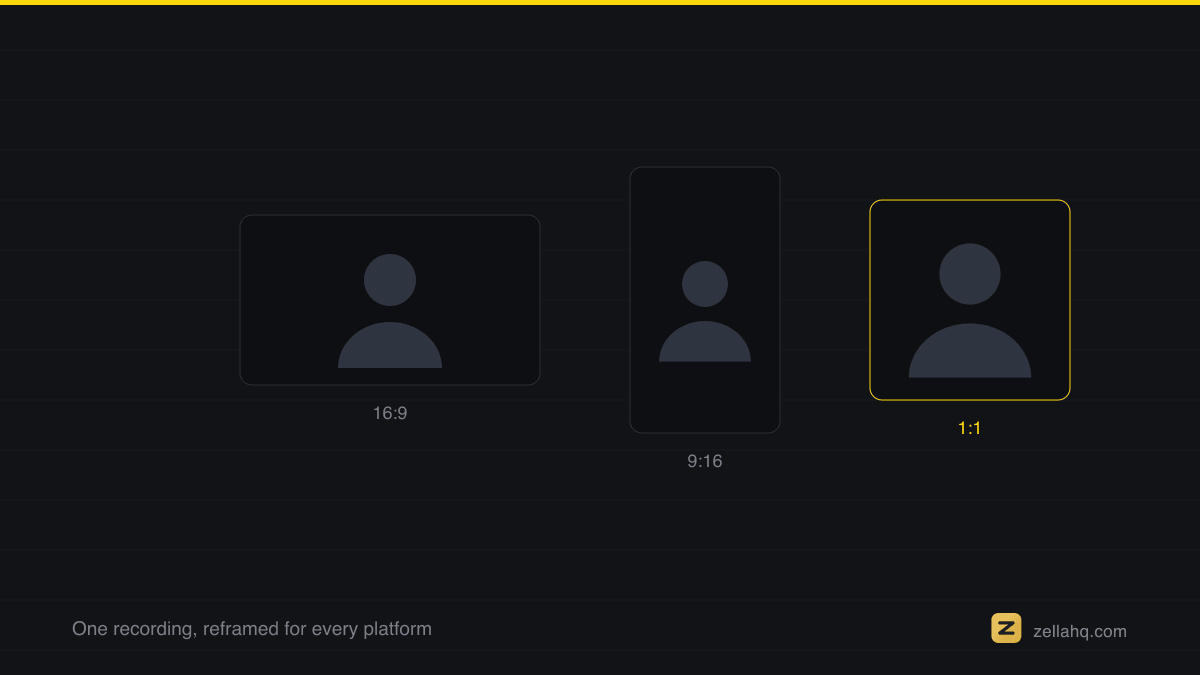
Length also depends on framing: a clip built for a 16:9 desktop recording needs reframing to vertical before it belongs on TikTok or Reels. Zella's one-click reframe to 9:16, 1:1, or 16:9 with face tracking keeps the subject centered so you are not sacrificing watchable seconds to bad cropping. For the mechanics of resizing, see how to resize a video for TikTok, Instagram, and YouTube and how to make a 9:16 reel from a screen recording.
Quick checklist before you post
- Match length to intent: tip (under 20s), story (21 to 40s), tutorial (40 to 90s).
- Front-load the hook - a clear promise or payoff tease in the first 1 to 2 seconds.
- Cut every silence and filler word; if a second is not earning its place, delete it.
- Add captions - most short-form is watched on mute, and captions lift completion.
- Reframe to 9:16 for TikTok, Reels, and Shorts; keep the subject centered.
- After posting, read your retention graph, not just the view count - find where people drop and cut that spot next time.
Frequently asked questions
What is the single best video length for short-form in 2026?
There is no universal number, but 21 to 34 seconds is the strongest all-around target across TikTok, Reels, and Shorts. It leaves room to tell a small story while staying short enough for most viewers to finish, which is what the algorithms reward.
Do longer videos get less reach?
Not automatically. Longer videos lose reach only when retention drops - the algorithm penalizes early drop-off, not length itself. A well-paced 60-second tutorial that holds attention can out-reach a padded 20-second clip. Length hurts you when it invites people to leave.
How long can a YouTube Short be in 2026?
Up to 3 minutes. Any vertical or square video under 3 minutes counts as a Short. But most winning Shorts still stay in the 15 to 60 second zone because completion rate falls as runtime climbs.
Should the same clip be a different length on each platform?
Usually a light trim is enough. Reels reward the shortest cuts (7 to 30 seconds), TikTok tolerates a touch more (21 to 34 seconds), and Shorts can stretch to 45 seconds. Cut the same core clip a few seconds tighter for Reels and you have covered all three.
Do captions actually affect how long people watch?
Yes. A large share of short-form video is watched with the sound off, so on-screen captions keep silent viewers engaged and measurably improve completion rate - the metric that drives reach. See how to automatically caption a video on Mac.
How do I know if my video is too long?
Check your retention graph. If a large share of viewers drop before the end, or your 3-second retention is under 60 percent, the video is either too long or the hook is weak. Trim to the moment people leave and test again.
Make your next video with Zella.
Record, edit and ship on Mac and iPhone - local, private, free to start.
RELATED