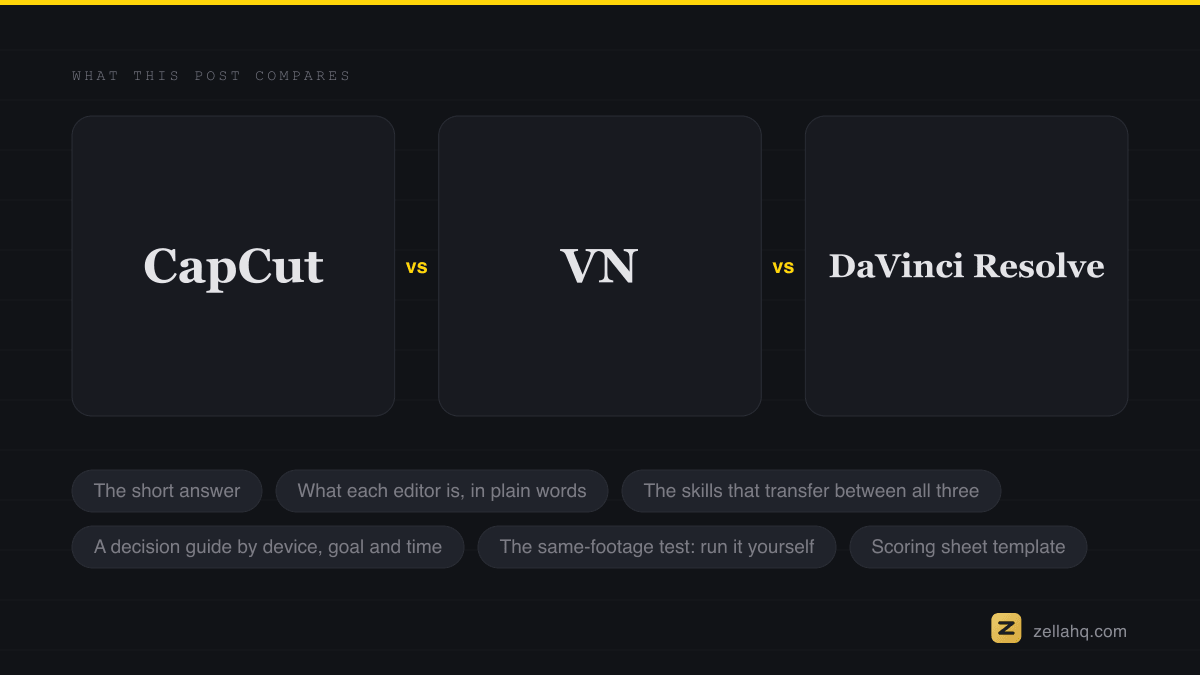
Learn CapCut first if you want to post short vertical videos soon, VN first if you edit on a phone and want a layered timeline without templates doing the work, and DaVinci Resolve first if you plan to edit long videos on a computer or want a career path in editing. The honest way to choose is a same-footage test: give each editor the same three clips, voice and music, run the same ten tasks, and time yourself. The skills that matter most, cutting, trimming, timing and sound, transfer between all three, so the first choice matters less than finishing ten videos in it.
On this page
- The short answer
- What each editor is, in plain words
- The skills that transfer between all three
- A decision guide by device, goal and time
- The same-footage test: run it yourself
- Scoring sheet template
- How to read your results
- A 30-day learning plan for whichever you pick
- Signs you picked the wrong first editor
- Mistakes beginners make when choosing
- Where Zella fits
- Resources and further reading
- Frequently asked questions
Beginners ask "which editor should I learn?" as if the answer locks them in for life. It does not. The core of editing, choosing shots, cutting at the right moment and keeping sound clear, works the same way in every editor. What changes is how fast you get your first finished video, and that decides whether you keep going.
This guide does not rank CapCut, VN and DaVinci Resolve with a score from a lab. It gives you a decision guide, then a test you can run on your own footage in an evening, so the answer fits your device, your goal and your patience. If you want app round-ups instead, see the best video editing apps for smartphones and the best video editing software for beginners.
The short answer
- You want to post Reels, TikToks or Shorts within a week: start with CapCut. Its templates and trend tools are built for exactly that.
- You edit on your phone and want to learn a proper layered timeline: start with VN. You build the edit yourself rather than filling in a template.
- You want to edit longer videos on a computer, or you think editing might become a job: start with DaVinci Resolve. It is the deepest of the three and the slowest to learn.
If two of those describe you, pick the one that matches the video you will make next week, not the one you might make next year.
What each editor is, in plain words
CapCut is a video editor built around short-form social video. Its strength is speed for social video: templates, effects, auto captions and trend formats sit one tap away. It is free to download, with paid plans sold as subscriptions. Its App Store listing shows Standard monthly at $9.99 and Pro monthly at $19.99 (checked 2026). Prices vary by region, so confirm them on CapCut's own site or the store listing before you rely on a paid feature.
VN is a mobile-first editor built around a multi-track timeline. Beginners tend to like it because it feels like a desktop editor shrunk onto a phone: you stack clips, text and music on layers and arrange them yourself. Check its current App Store listing for plans and features, because they change.
DaVinci Resolve is a professional post-production application from Blackmagic Design. Blackmagic's product page describes it as editing, colour correction, visual effects, motion graphics and audio post in one tool. There is a free version, and a paid Studio version at $295 once (checked 2026). It is a computer application first, with an iPad version as well. It asks the most of you and your hardware, and it gives the most back.
The skills that transfer between all three
Whatever you pick, these are the skills you are really learning. Every one of them carries over if you switch later.
| Skill | What it means | Why it matters |
|---|---|---|
| Trim | Cut the start and end of a clip | The edit gets tight |
| Split | Cut one clip into two at the playhead | You remove the bad middle |
| Ripple delete | Remove a piece and close the gap | No black holes in your timeline |
| Layers | Stack text, music or a second clip over the main one | Titles, music, picture-in-picture |
| Keyframes | Set a value at two points in time and let the editor move between them | Zooms, slides, fades |
| J-cut and L-cut | Sound starts before, or carries after, the picture cut | Edits that feel smooth, not choppy |
| Audio levels | Voice loud, music quiet, no clipping | Viewers stay |
| Colour | Match shots, then give them a look | Shots feel like one video |
| Export settings | Resolution, frame rate, shape | The file plays right everywhere |
If any word in that table is new, video editing terms explained defines the rest of the vocabulary, and what J-cuts and L-cuts are explains the one most beginners skip.
A decision guide by device, goal and time
| If this is you | Learn first | Why |
|---|---|---|
| Phone only, posting short videos | CapCut | Fastest path to a finished social video |
| Phone only, want to build edits yourself | VN | Layered timeline teaches structure |
| Computer, long YouTube videos | DaVinci Resolve | Built for long timelines and finishing |
| Computer, short videos only | CapCut or Resolve | CapCut for speed, Resolve for depth |
| Older or low-power computer | A phone editor first | Resolve is demanding on hardware |
| Want to work as an editor | DaVinci Resolve | Professional workflow and vocabulary |
| Only 30 minutes a week to learn | CapCut or VN | Short learning curve per session |
Two questions settle most cases. Where will you edit: phone or computer? And how long are your videos: under a minute, or over ten?
The same-footage test: run it yourself
Reviews disagree because every reviewer brings different footage and habits. The fix is to test on yours. This protocol takes one evening per editor, and it is fair because every editor gets the same material and the same tasks.
Prepare the test kit once:
- Three clips of 20 to 30 seconds each from your phone: one of you talking, one of hands doing something, one wide shot.
- One voice line recorded separately, about 10 seconds.
- One music track you have the right to use.
- A notes app with a timer.
Rules: install each editor fresh. Allow yourself one tutorial video of up to ten minutes per editor, no more. Time each task from the moment you start it.
The ten tasks:
- Import all three clips and put them in order.
- Trim the talking clip so it starts on your first word.
- Split the hands clip and delete the middle 5 seconds, closing the gap.
- Add the music and lower it so the voice is clearly louder.
- Add automatic captions and correct one wrong word.
- Add a title over the first two seconds.
- Add one zoom-in using keyframes or the editor's zoom tool.
- Apply one colour look to all three clips.
- Change the shape to vertical 9:16 without cutting off your face.
- Export a 1080p file and play it back.
Scoring sheet template
Copy this table into your notes and fill it in once per editor.
| Task | Minutes | Needed help? (Y/N) | Result OK? (Y/N) | Note |
|---|---|---|---|---|
| 1. Import and order | ||||
| 2. Trim to first word | ||||
| 3. Split and close gap | ||||
| 4. Music under voice | ||||
| 5. Captions and fix | ||||
| 6. Title | ||||
| 7. Zoom | ||||
| 8. Colour look | ||||
| 9. Vertical reframe | ||||
| 10. Export and check | ||||
| Total |
Then answer three questions in a sentence each: Which editor did I enjoy using? Which export did I like watching? Which one would I open again tomorrow?
How to read your results
- Total time matters less than "needed help". A task you finished slowly but alone is a task you learned. A task you could not find without a video will slow you down every time.
- Watch the export, not the project. Check the corners and the end of each file for a logo or end card, and confirm the length and resolution you expected. Free tiers change, so the export is the only proof.
- The editor you would open tomorrow wins ties. Learning is repetition. The tool you avoid teaches you nothing.
- Write down the missing tasks. If an editor could not do task 5 or task 9 the way you need, that is a real limit for your kind of video.
A 30-day learning plan for whichever you pick
| Week | Goal | Output |
|---|---|---|
| 1 | Cuts and trims only | Three 30-second videos with no effects |
| 2 | Sound | Same three videos, re-edited with music under voice and clean levels |
| 3 | Text and captions | Two new videos with captions and a hook title |
| 4 | Colour and shape | One video exported in vertical and horizontal |
Finishing ten short videos teaches more than one long one. Keep every export, then watch video 1 and video 10 side by side at the end of the month.
Signs you picked the wrong first editor
Give any editor two weeks of regular use before judging it. After that, these are honest signals to switch:
- You avoid opening it. If you put off editing because the app feels like hard work, the tool is costing you practice. A simpler editor you use daily beats a powerful one you open once a week.
- Every video looks like a template. If your edits start to look like everyone else's, you may be leaning on presets. A layered timeline such as VN, or a computer editor such as Resolve, makes you build the shape yourself.
- You keep hitting the same wall. Long timelines that stutter, colour you cannot control, or audio you cannot fix are signs you have outgrown a quick social editor.
- Your computer struggles. If playback stutters on a simple timeline in Resolve, edit on a lighter tool and come back when you have better hardware or smaller files.
- You spend longer on tutorials than on edits. That is a sign the tool is too deep for where you are today. Step down a level, finish ten videos, then step back up.
None of these mean you wasted the time. Every cut you made in the first editor still counts in the next one.
Mistakes beginners make when choosing
- Picking the most powerful tool for a simple job. Resolve for a 20-second Reel is a long road to a short video.
- Switching editors every week. Each switch resets your muscle memory. Give one editor a month.
- Learning effects before cuts. Transitions and filters do not save a slow edit. Cutting does.
- Trusting a round-up's verdict over your own test. Your footage, your device and your patience are the variables.
- Ignoring where the files go. Some editors work on the device and some sync projects to an account. Read the privacy settings before you import personal footage.
Where Zella fits
Zella is not one of these three, and it is not a replacement for DaVinci Resolve's depth. It is a screen recorder and video editor for Mac and iPhone that automates the parts beginners find slowest. Auto-Polish cuts silences and filler words, polishes the voice and adds music in one tap. Captions are made on the device, Make Vertical reframes to 9:16 while tracking your face, and the timeline still lets you cut, trim and ripple-delete by hand, so you learn the same core skills.
You can run the same ten-task test on it. The free tier has no watermark and no account, and exports at 1080p up to 2 minutes each. Zella Pro is a one-time purchase that removes the length cap and adds 4K and the depth tools such as keyframe curves and speed ramps. Zella is only for Mac and iPhone, so if you edit on Windows or Android it is not an option. Zella is free to start on the App Store, or from the download page for Mac and iPhone. For one-to-one comparisons, see Zella vs CapCut and Zella vs DaVinci Resolve.
Resources and further reading
- DaVinci Resolve training from Blackmagic Design: free official courses with practice footage, the best structured start if Resolve is your pick.
- DaVinci Resolve: Blackmagic's product page, with what the free version includes and the system requirements.
- CapCut: CapCut's own site, for current plans and platforms.
- Zella's editor overview: where the cut, trim, caption and reframe tools sit, if you run the ten-task test on Zella. The editor features page summarises them.
If you want a course to follow alongside the test, the best online video editing courses compares the free and paid options.
Frequently asked questions
Is CapCut or DaVinci Resolve better for beginners? CapCut is easier to start with and faster for short social videos. DaVinci Resolve is harder to learn but goes much further, especially for long videos, colour and audio on a computer.
Is VN easier than CapCut? They suit different habits. CapCut leans on templates and one-tap effects, while VN asks you to build the edit on layers yourself. Run the ten-task test on both to see which way of working suits you.
Is DaVinci Resolve free? There is a free version, and a paid Studio version at $295 once (checked 2026). Check Blackmagic Design's site for what the free version includes today.
Can I learn video editing on my phone? Yes. Trimming, splitting, layering, sound levels and captions all work the same way on a phone, and the skills carry over to a computer editor later.
How long does it take to learn video editing as a beginner? Most people can finish a simple, clean short video within a week of regular practice. Making ten short videos in a month is a realistic first goal.
Should I switch editors later? Switch when you hit a real limit, such as video length, colour control or a missing feature, not because a new tool is popular. Your editing skills come with you.
Written by
Nasir Uddin Shamim
Founder of Zella
Nasir Uddin Shamim is the founder of Zella. He built his career in SEO, AI, and marketing - never short on ideas, but every one of them hit the same wall: turning a raw recording into a video worth posting. Like most beginners, he burned hours fighting complicated editors and shipped far less than he wanted to. So he built Zella, a screen recorder and AI editor for Mac and iPhone that does the hard parts for you - first to unblock himself, and now to help anyone go from raw clip to polished video without the learning curve.
More from Zella: fresh tutorials on the channels above, plus product updates and editing tips straight to your inbox.
Make your next video with Zella.
Record, edit and ship on Mac and iPhone - local, private, free to start.
RELATED