To turn 30 minutes of raw footage into a 60-second reel, keep about 1 second in every 30. Work in five passes: decide the one idea, log the footage with simple markers, pull 5 to 8 minutes of selects, build a paper edit against a time budget (hook 0 to 3 seconds, setup to 10, three beats to 45, payoff to 55, close to 60), then rough cut to about 90 seconds and cut down to 60. Change the picture every 3 to 6 seconds, start on the strongest moment and finish on the result. A 60-second reel fits inside Zella’s free export limit of 2 minutes at 1080p.
On this page
- The 30 to 1 ratio, and what it means for your plan
- Pass 0: Decide the one idea before you watch anything
- Pass 1: Log the footage with four markers
- Pass 2: Pull 5 to 8 minutes of selects
- Pass 3: Build a paper edit against a time budget
- Pass 4: Rough cut to 90 seconds, then cut down to 60
- Pacing rules that keep 60 seconds moving
- A worked example structure
- Sound, captions and the last ten percent
- Mistakes that keep a reel at 3 minutes
- Where Zella fits
- Resources and further reading
- Frequently asked questions
Thirty minutes of footage and a 60-second reel means you will throw away 29 minutes. That is not waste. It is the job. Editing a reel is mostly deciding, and the reason it feels overwhelming is that people try to decide everything at once, scrolling back and forth through half an hour of clips.
This guide breaks it into passes, each with its own time budget and a clear output. It covers one reel from one pile of footage. If you want to pull many clips from one long recording instead, see how to repurpose one long video into short clips. If you are cutting a music-driven montage of best moments, how to make a highlight reel is the closer guide.
The 30 to 1 ratio, and what it means for your plan
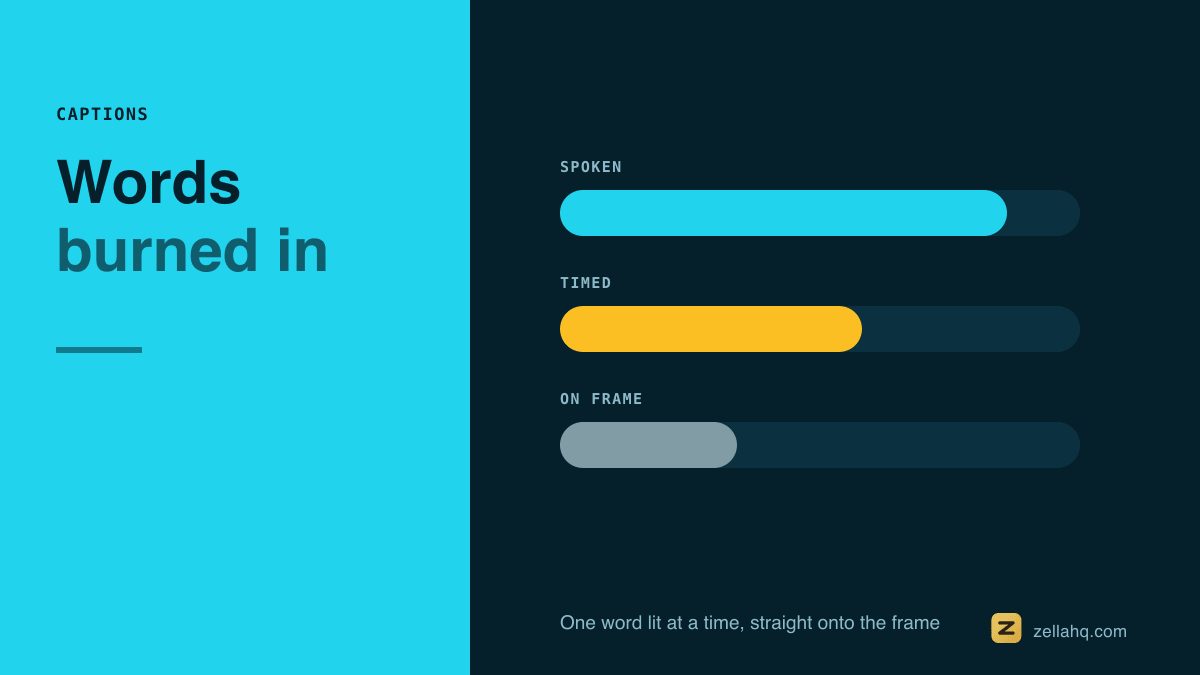
Thirty minutes is 1,800 seconds. A 60-second reel keeps 60 of them, or about 3%. Put another way, every second on screen has to beat 29 others.
That ratio decides the method. You cannot judge 1,800 seconds against each other in your head, so you narrow in steps:
| Pass | Input | Output | Time budget |
|---|---|---|---|
| 0. The idea | Your memory of the shoot | One sentence | 5 min |
| 1. Log | 30 min of footage | A list of marked moments | 40 min |
| 2. Selects | Marked moments | 5 to 8 min of usable clips | 20 min |
| 3. Paper edit | Selects | A second-by-second plan | 15 min |
| 4. Rough cut and cut-down | The plan | A 60 s edit | 45 min |
| 5. Finish | The 60 s edit | Captions, sound, export | 30 min |
About two and a half hours in total for a first attempt. It gets faster each time, mostly in passes 1 and 4.
Pass 0: Decide the one idea before you watch anything
Write one sentence: "This reel shows (who or what) (doing what), so the viewer (feels or learns what)." For example: "This reel shows a pottery class turning lumps of clay into finished mugs, so the viewer wants to book one."
Every later decision is a test against that sentence. A beautiful shot that does not serve it gets cut. That is the hardest part of editing from a large pile of footage, and having the sentence written down makes it much easier.
Pass 1: Log the footage with four markers
Watch everything once, at 1.5 or 2 times speed if your editor allows, and mark moments as you go. Use only four labels so you do not slow down:
- H for hook: a striking image or line that could open the reel.
- B for beat: a moment that moves the story forward.
- P for payoff: a result, reaction or reveal.
- X for texture: a short cutaway that sets the place or mood.
Keep a log in your notes app with this shape:
| Clip | Time in clip | Label | What happens | Quality (1 to 3) |
|---|---|---|---|---|
| 04 | 0:12 | H | Hands slam clay on the wheel | 3 |
| 07 | 1:40 | B | Teacher shows the pull-up | 2 |
| 11 | 0:05 | X | Shelf of glazes, slow pan | 2 |
| 19 | 2:10 | P | Student lifts the finished mug, laughs | 3 |
Do not trim anything in this pass. Do not judge too hard either. If you hesitate, mark it with a 1 and move on.
Pass 2: Pull 5 to 8 minutes of selects
Now go through the log, not the footage. Copy only the moments rated 2 or 3 into a selects sequence, a separate timeline that holds the good stuff. Aim for 5 to 8 minutes. That is your pile cut by about three quarters, and every clip in it is worth considering.
Rules for this pass:
- Keep two or three seconds of handle either side of each moment. You will need it to place cuts.
- Keep every H and every P rated 3, even if they repeat. You will pick the best one later.
- Leave out anything shaky, out of focus or badly lit unless it is the only copy of a key moment.
- If you have audio that carries the story, such as someone explaining, keep those lines together even if the picture is weak. You can cover weak picture with cutaways.
Pass 3: Build a paper edit against a time budget
A paper edit is the reel written as a list before you touch the timeline. It is the fastest way to see whether your story fits in 60 seconds. Start with this budget:
| Section | Time | Job | Shots |
|---|---|---|---|
| Hook | 0 to 3 s | Stop the scroll with the best H or P | 1 to 2 |
| Setup | 3 to 10 s | Say where we are and what is about to happen | 2 to 3 |
| Beat 1 | 10 to 22 s | First step of the story | 3 to 4 |
| Beat 2 | 22 to 34 s | Second step, slightly more interesting | 3 to 4 |
| Beat 3 | 34 to 45 s | The turn: hardest or most surprising part | 3 to 4 |
| Payoff | 45 to 55 s | The result, the reaction | 2 to 3 |
| Close | 55 to 60 s | A final line, call to action or loop back | 1 |
That is roughly 15 to 21 shots, so an average shot lasts about 3 to 4 seconds. Fill each row from your selects, writing the clip number and time beside it. If a section has nothing strong, shrink it and give its seconds to a section that does. The budget is a starting point, not a law.
Many reels open with the payoff, then show how it happened. If your best moment is the finished result, put a 1 to 2 second flash of it in the hook, and let the full version land again at 45 seconds. For opening patterns, see the best hooks for short-form video.
Pass 4: Rough cut to 90 seconds, then cut down to 60
Build the paper edit on the timeline. It will almost always run long, often around 90 seconds. That is fine. Cutting down in rounds is easier than trying to hit 60 on the first try.
The cut-down ladder:
- 90 to 75 seconds: remove whole shots. Find the weakest shot in each section and delete it. Do not trim yet. Removing a whole shot saves the most time with the least damage.
- 75 to 65 seconds: trim heads and tails. Start every shot on movement and end it the moment the action lands. Remove pauses between spoken lines.
- 65 to 60 seconds: merge and tighten. Where two shots show the same idea, keep the better one. Shorten the setup, which is almost always the slackest section.
After each round, watch the whole reel from the start without stopping. Problems in pacing only show up when you watch at real speed.
Pacing rules that keep 60 seconds moving
- Change the picture every 3 to 6 seconds. A cut, a zoom or a new angle all count. Longer than that on an unchanged frame and attention drifts; far shorter, sustained, and it reads as noise. How often you should cut goes into the reasoning.
- Speed up as you go. Let the setup breathe a little, then shorten shots through beats 2 and 3 so the reel builds.
- Cut on action. Cut while a hand is moving or a head is turning. The movement hides the join.
- Use jump cuts on talking. When someone speaks to camera, cutting the pauses out of one shot is normal in a reel. What jump cuts are explains when they look right.
- Cover weak picture. If a spoken line is great and the shot is dull, lay a cutaway over it. What b-roll is and how to use it covers this in depth.
- Let one moment breathe. The payoff can hold for a beat longer than everything else. A small pause makes it land.
A worked example structure
Here is the pottery example as a finished plan. The clip numbers are placeholders for your own log; the structure is what to copy.
| Time | Shot | Source | Sound |
|---|---|---|---|
| 0.0 to 1.5 | Finished mug held up | Clip 19 | Music starts on a beat |
| 1.5 to 3.0 | Clay slammed on the wheel | Clip 04 | Thud, title "From lump to mug" |
| 3.0 to 6.0 | Wide of the studio | Clip 02 | Teacher: "Today you make your first mug" |
| 6.0 to 10.0 | Students sitting down, close-ups | Clips 03, 05 | Music |
| 10.0 to 22.0 | Centering the clay, four shots | Clips 06 to 09 | Teacher line on hand position |
| 22.0 to 34.0 | Pulling the walls, four shots | Clips 10 to 14 | Laugh as one collapses |
| 34.0 to 45.0 | Trimming and the handle, three shots | Clips 15 to 17 | Music builds |
| 45.0 to 55.0 | Glazes, kiln door, mug revealed | Clips 11, 18, 19 | Student: "I made that" |
| 55.0 to 60.0 | Row of finished mugs | Clip 20 | Text: "Book a class" |
Notice the hook is two shots in three seconds, the busiest stretch has shots of about three seconds, and the reveal gets the longest hold.
Sound, captions and the last ten percent
- Voice first, music second. Keep spoken lines clearly above the music. Lift quiet clips individually.
- Caption every spoken word. Many viewers watch muted, and captions also carry the story across cuts.
- Put the title in the first three seconds, in the middle of the frame, away from the bottom edge where app buttons sit.
- Check the loop. Reels replay automatically. If the last frame cuts cleanly back to the first, people often watch twice.
- Export vertical 9:16 at 1080p. For the shape question, making a video vertical on iPhone has the details.
Mistakes that keep a reel at 3 minutes
- Editing before logging. Trimming clips one by one as you first watch them is the slowest possible method.
- Keeping a shot because it was hard to get. The viewer does not know what it cost you.
- Explaining instead of showing. If a shot shows it, cut the line that says it.
- Three hooks in a row. Pick one opening. The others can be the payoff.
- Ending on a fade to black. End on the result or a line that loops.
- Not watching at full speed. Pacing problems are invisible when you scrub.
Where Zella fits
Zella is a screen recorder and video editor for iPhone and Mac, and several passes map onto its tools directly:
- Logging talking footage: add captions first, then use transcript editing on iPhone to read the recording as text and delete lines, which cuts the video to match.
- Tightening: Clean Up removes silences and filler words, and Auto-Polish adds cuts at your natural pauses, voice polish and music in one pass, which you can refine by hand.
- Building from many clips: the multi-clip timeline handles cut, trim, ripple-delete and reorder, and Add > Clip from another project pulls in takes from other Zella projects without exporting them first.
- Finishing: on-device captions, Make Vertical for 9:16 with face tracking, and export presets for Reels, TikTok and Shorts.
- Finding moments in long talks: on iPhone, Best moments as Shorts in the Export sheet finds the strongest 15 to 60 second stretches from what was said. It needs captions first and is part of Zella Founder.
The free tier has no watermark and no account, and exports at 1080p up to 2 minutes each, so a 60-second reel fits without paying. Zella Pro is a one-time purchase that removes the length cap and adds 4K. Zella runs on Mac and iPhone only. You can download Zella free from the App Store or from the download page, and the features page lists the rest.
The passes in Zella on iPhone, in order:
- Add > Clip from another project or import from Photos to gather your footage on one timeline.
- Tap Captions so every spoken line becomes text you can read and search.
- Use transcript editing to delete the lines you will not use. The video is cut to match.
- Tap Auto, then Clean up to remove the silences and filler words left in the kept lines.
- Trim and reorder by hand to follow your paper edit, using the cut-down ladder above.
- Tap Make Vertical for a 9:16 frame that keeps faces centred.
- Export with the Reels, TikTok or Shorts preset at 1080p, then play the file once before posting.
The on-device AI guide covers Clean up, transcript editing and Make Vertical in detail, and the cleanup features page shows them on a real clip.
Resources and further reading
- Zella on-device AI guide for iPhone: Auto-Polish, Clean up, transcript editing and Make Vertical, step by step.
- Best moments in Zella: how Zella finds 15 to 60 second stretches in a long talk.
- YouTube Shorts for creators from YouTube: the vertical format's own guidance.
- How to upload videos on TikTok from TikTok's help centre.
Frequently asked questions
How long does it take to edit a 60-second reel? For a first attempt from 30 minutes of footage, plan on about two and a half hours using the passes above. Logging and cutting down take the most time, and both get faster with practice.
How many clips should a 60-second reel have? Around 15 to 20 shots is a common range, which gives an average of 3 to 4 seconds per shot. Talking reels can use fewer shots with jump cuts inside them.
What is a paper edit? A paper edit is the reel written as a list of shots and timings before you build it on the timeline. It shows whether the story fits the length before you spend time cutting.
How do I choose the best clips from a lot of footage? Watch everything once at faster speed and mark only hooks, story beats, payoffs and short cutaways. Then build your edit from the marked list, not from the raw footage.
Should a reel start with the ending? Often, yes. Flashing the result in the first one or two seconds gives viewers a reason to stay, and the full reveal can land again near the end.
What should I cut first when a reel is too long? Remove whole weak shots first, then trim the start and end of each remaining shot, then tighten the setup section, which is usually the slowest part.
Written by
Nasir Uddin Shamim
Founder of Zella
Nasir Uddin Shamim is the founder of Zella. He built his career in SEO, AI, and marketing - never short on ideas, but every one of them hit the same wall: turning a raw recording into a video worth posting. Like most beginners, he burned hours fighting complicated editors and shipped far less than he wanted to. So he built Zella, a screen recorder and AI editor for Mac and iPhone that does the hard parts for you - first to unblock himself, and now to help anyone go from raw clip to polished video without the learning curve.
More from Zella: fresh tutorials on the channels above, plus product updates and editing tips straight to your inbox.
Make your next video with Zella.
Record, edit and ship on Mac and iPhone - local, private, free to start.
RELATED